
Technical guide
How to Choose a VFD: A Practical 9-Step Guide for Industrial Applications
Select the right VFD by motor current, load type, control mode, environment, power quality and brand fit—not horsepower alone.
Jack Dean writes practical VFD selection, wiring, replacement and power-quality guides using current manufacturer documentation and explicit procurement checks.
Author profile
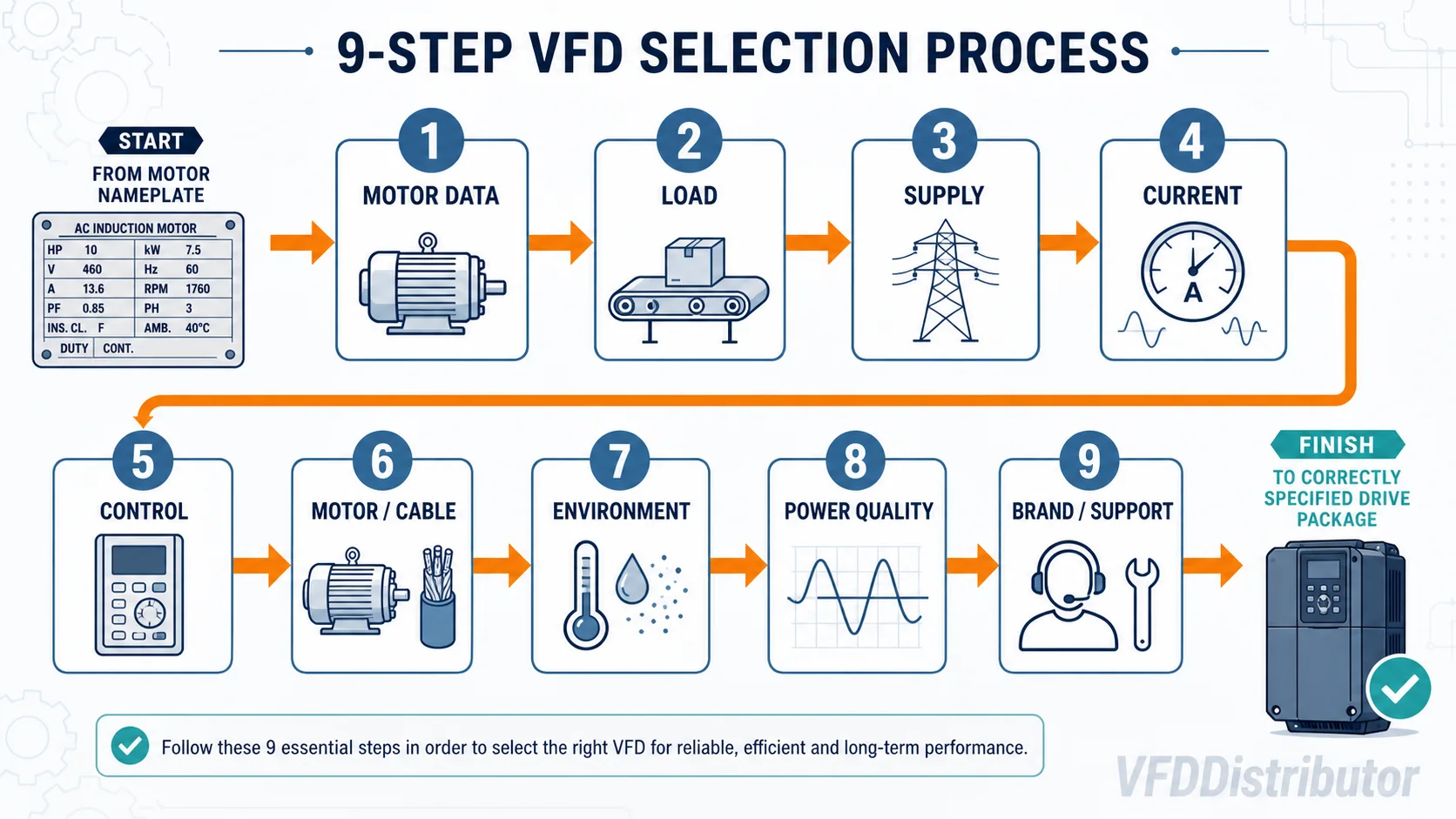
The best VFD is not automatically the most expensive drive or the biggest name on the shortlist. It is the drive whose continuous output current, overload capability, control method, environmental rating, communications and motor compatibility match the real application.
That is the short answer to how to choose a VFD. Start with the motor and load, then select the product family and brand. Reversing that order is how buyers end up with a well-known drive that trips at startup, overheats in the cabinet or cannot communicate with the installed PLC.
This guide turns VFD selection into nine practical steps. It applies to new systems, retrofits and discontinued-model replacements. If the technology itself is new to you, begin with what a VFD is and how it works.
Information to collect before selecting a VFD
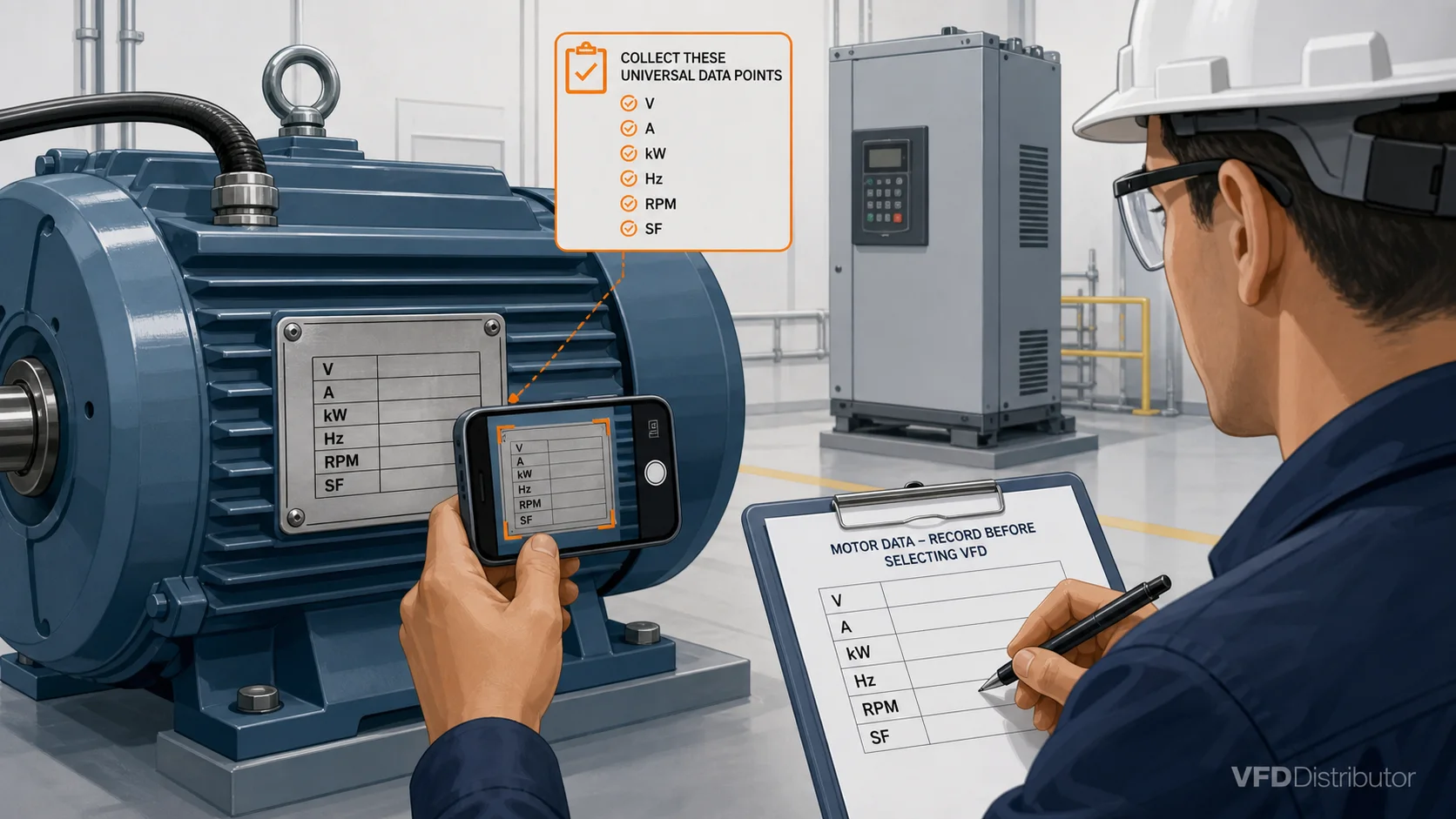
A supplier can make a much better recommendation when the enquiry includes:
- A clear photo of the motor nameplate
- Motor rated voltage, full-load current, power, frequency and speed
- Available input voltage and phase
- Load type and machine function
- Required minimum and maximum speed
- Starting torque, acceleration and stopping requirements
- Ambient temperature, altitude, dust, moisture and installation location
- PLC brand and required communication protocol
- Motor cable length
- Required enclosure, safety and harmonic performance
- Destination country and required certifications
If the existing drive is being replaced, also photograph its complete type code, option cards, terminals and parameter backup. A base series name is rarely enough to identify a true drop-in replacement.
Step 1: Read the motor nameplate
Motor power in kW or hp is useful for shortlisting, but the drive ultimately has to supply current. Record the motor's:
- Rated voltage and phase — these must be compatible with the VFD output and site supply.
- Full-load current (FLA) — the primary starting point for drive sizing.
- Rated frequency and speed — required for setup, slip compensation and speed limits.
- Service factor or duty information — relevant when the motor is expected to operate above its nominal load.
- Insulation and inverter-duty marking — important for PWM voltage stress, cable length and speed range.
Two motors with the same horsepower can have different rated currents. Likewise, a drive may have different current ratings for normal-duty and heavy-duty operation. Compare amperes under the intended duty rating, not only the large kW number on the product page.
Step 2: Define the load before choosing the duty rating
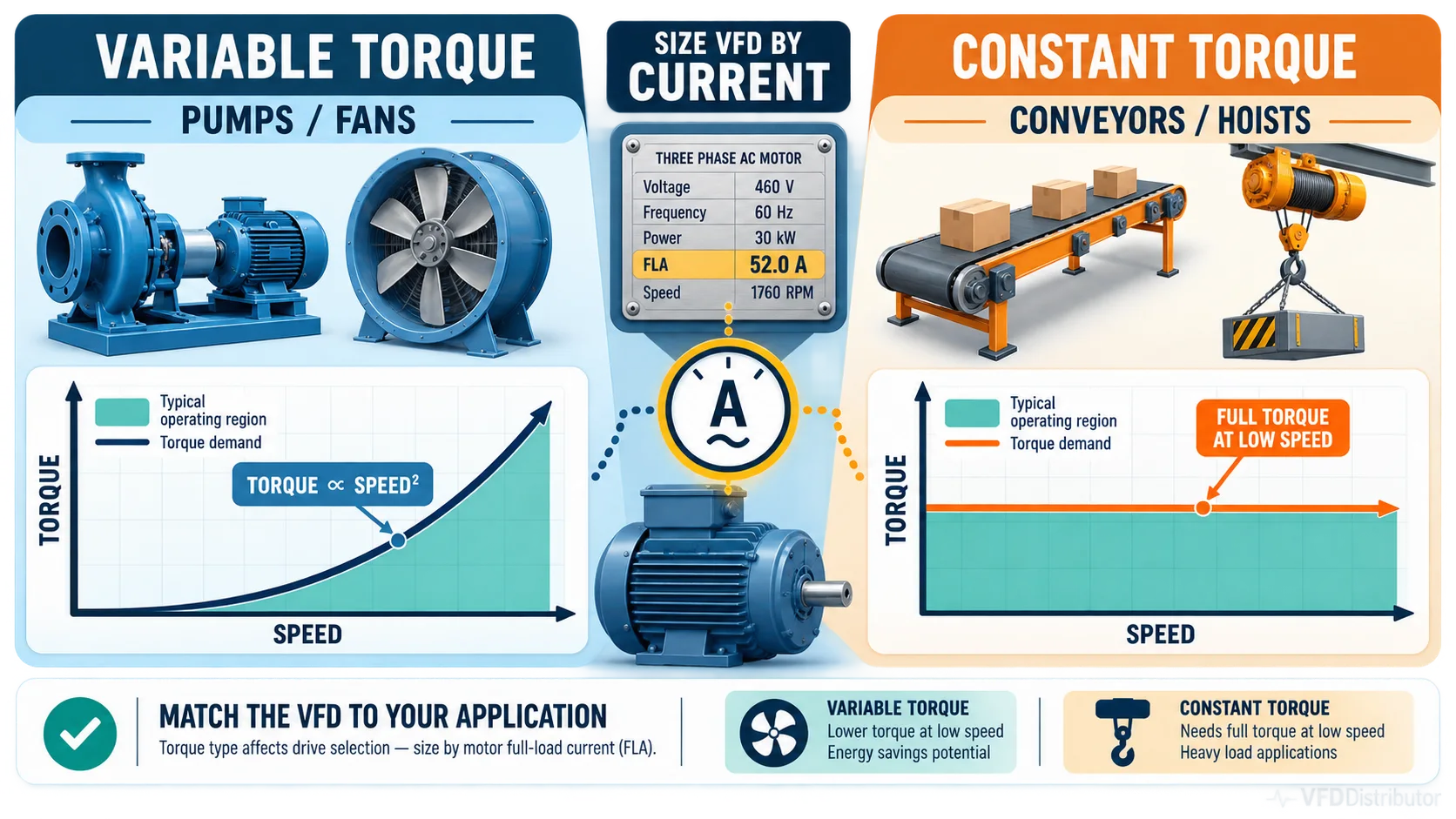
The machine determines how much torque and overload capability the VFD must provide.
| Application | Typical load behavior | Common starting point | Questions that change the selection |
|---|---|---|---|
| Centrifugal pump or fan | Variable torque | V/f or sensorless vector; normal-duty rating may be suitable | Minimum flow, sleep mode, multi-pump control, dry-run protection |
| Conveyor or mixer | Constant torque | Sensorless vector and heavy-duty current | Loaded starts, low-speed operation, reversing and jam torque |
| Compressor | Constant torque with possible high starting demand | Heavy-duty drive; verify breakaway torque | Unloading sequence, minimum speed, restart limits and process interlocks |
| Hoist or crane | Overhauling load with high safety demands | Application-specific vector drive, often with feedback | Brake control, encoder, load holding, regenerative energy and functional safety |
| Winder or spindle | Constant power or high dynamic response | Vector or closed-loop control | Field-weakening range, tension, positioning and rapid speed changes |
Swipe or scroll horizontally to see all columns.
Do not assume every pump is variable torque or every conveyor has the same duty. Positive-displacement pumps, inclined conveyors and high-viscosity mixers can demand much more torque than their broad equipment category suggests. For pump-specific duty, PID and protection checks, use VFDs for pumps.
Step 3: Confirm the electrical supply
Check the actual supply, not the nominal value used in a previous project:
- Input voltage range and frequency
- Single-phase or three-phase input
- Grounding system
- Available fault current and required protective devices
- Transformer size and impedance
- Whether a generator, weak grid or large switching loads share the supply
A VFD does not create a higher output voltage than the available input. A 400 V motor normally needs a suitable 400 V-class supply and drive. Single-phase input can power a three-phase motor only when the selected VFD is explicitly rated for that input arrangement or is applied with the manufacturer's approved derating. Never assume that removing one input phase from a standard three-phase drive is acceptable. If your site only has single-phase power, use the single-phase to three-phase VFD checklist to record that permission, the single-phase derating and the supply review against document pages before you order.
Step 4: Size by current, duty and derating—not horsepower alone
Use this sequence:
- Find the motor nameplate current.
- Select the drive's normal-duty or heavy-duty table based on the load.
- Confirm that continuous output current covers the motor current.
- Confirm that short-term overload current and duration cover acceleration, breakaway and process peaks.
- Apply the manufacturer's temperature, altitude, carrier-frequency and enclosure derating.
- Move to the next suitable frame when the corrected current is insufficient.
For example, if a motor is rated at 46 A, a VFD whose usable continuous current becomes 43 A after high-temperature derating is too small even if both products are advertised under the same horsepower class.
For multiple motors on one drive, the drive must cover the combined current and the system needs suitable individual motor protection. For one drive operating several motors sequentially or by contactors, consult the manufacturer because switching on the VFD output can damage the drive when handled incorrectly. When the shop has no three-phase utility service and the choice is one controlled motor or a supply for the rest of the machine, use VFD vs rotary phase converter and fill in that load inventory before ordering.
Oversizing is not a universal cure. A much larger drive costs more, increases cabinet and protection requirements, and may have limits on motor identification or current measurement with a very small motor. Choose the correct frame with justified margin.
Step 5: Match the control method to the job
| Control method | Good fit | Main limitation |
|---|---|---|
| V/f (volts per hertz) | Basic speed control for many pumps, fans and simple loads | Weaker low-speed torque and less accurate speed regulation |
| Sensorless vector control | Conveyors, mixers, compressors and applications needing stronger low-speed torque | Requires correct motor data and tuning; not equal to encoder feedback |
| Closed-loop vector control | Hoists, winders, positioning and demanding torque or speed regulation | Adds encoder hardware, wiring and commissioning complexity |
| Manufacturer-specific high-performance control | Fast torque response or specialized process applications | Capability and setup vary by product family; verify the exact manual |
Swipe or scroll horizontally to see all columns.
Also confirm motor technology. Permanent-magnet and synchronous-reluctance motors require a drive with the correct control algorithm. A VFD that runs a standard induction motor is not automatically compatible with every high-efficiency motor.
Step 6: Check the motor, cable and braking system
A correct drive can still produce an unreliable system if the motor side is ignored.
At low speed, a shaft-mounted motor fan turns slowly and provides less cooling. Continuous high-torque operation at low frequency may require motor derating or independent forced ventilation. Long motor cables increase reflected-wave voltage stress and may require an output reactor, dV/dt filter or sine-wave filter according to the drive and motor manuals. Large motors or long cables can also require bearing-current mitigation.
Next, define stopping behavior. A high-inertia load or an overhauling load returns energy to the DC bus during deceleration. The solution may be a longer ramp, a braking chopper and resistor, a regenerative unit or an active front-end drive. A parameter change cannot replace missing braking hardware. If a resistor is the answer, the braking resistor duty record lists the drive, stop and resistor data to collect before one is chosen.
For a new motor-and-drive package, compare the VFD together with the industrial motor, cable and mechanical speed range. For an older motor, inspect insulation condition before assuming it is suitable for inverter operation. The VFD wiring guide explains the line-side, motor-side and grounding checks that follow selection.
Step 7: Design for the real environment
The enclosure label is only one part of environmental suitability. Check:
- Maximum and minimum ambient temperature
- Altitude and the manufacturer's derating curve
- Dust, conductive particles, humidity, condensation and corrosive gases
- Washdown or outdoor exposure
- Vibration and mounting orientation
- Required clearances and airflow
- Heat produced by the VFD, reactors, filters and braking resistors
An IP20 drive inside a well-designed VFD panel can be more reliable than a high-IP wall-mounted drive installed without enough cooling. Calculate panel heat dissipation and do not place braking resistors where their heat is recirculated through the VFD.
Step 8: Specify power quality, EMC, safety and communications
These items often distinguish two otherwise similar drives.
Power quality: determine whether the project needs AC or DC reactors, passive or active harmonic filters, a multi-pulse arrangement, an active front end or a low-harmonic drive. Harmonic compliance is assessed at the system's point of common coupling, so a product-level THDi headline is not a complete study. Review the complete power-quality solution and the detailed guide to VFD harmonics and line reactors.
EMC: verify the required EMC category, cable type, shield termination, grounding and motor cable length. Input filters and motor-side filters solve different problems.
Safety: identify Safe Torque Off and any additional functions required by the machine risk assessment. A drive's safety feature does not replace the system-level safety design.
Communications: list the exact network and profile—such as PROFINET, EtherNet/IP, Modbus TCP/RTU, PROFIBUS, CANopen or BACnet. Confirm whether it is built in, requires an option card, or depends on a particular control unit and firmware.
Step 9: Choose the brand by application fit and lifecycle support
Brand comparison becomes useful only after the specification is clear. The following is a positioning guide, not a universal ranking:
| Brand | Often shortlisted when | Verify on the exact series |
|---|---|---|
| ABB | Broad industrial standardization, process duty, advanced motor control or low-harmonic/regenerative options | Duty current, control variant, enclosure, fieldbus, braking and harmonic package |
| Siemens | The plant uses SIMATIC, PROFINET and TIA Portal, or needs modular automation integration | Compatible control/power modules, safety options, licenses and regional availability |
| Schneider Electric | Machine, water, HVAC or process applications using Altivar and EcoStruxure/Modicon ecosystems | Application family, embedded services, communication and filtering options |
| Yaskawa | General machinery and demanding motor-control applications where practical commissioning matters | Normal/heavy-duty current, feedback, braking, network option and replacement path |
| Delta Electronics | Cost-conscious OEMs and standard standalone machinery with adequate local support | Regional certifications, documentation, service, firmware and built-in versus optional features |
Swipe or scroll horizontally to see all columns.
The lowest purchase price is not necessarily the lowest installed cost. Include option cards, reactors, filters, enclosure, cooling, bypass, braking, commissioning time, spares, training and downtime exposure—and use our VFD installation cost quote checklist to level competing panel and contractor proposals line by line. A familiar platform can reduce engineering time; a locally stocked replacement can reduce outage risk.
For a wider shortlist, see our comparison of 16 VFD manufacturers.
Five common VFD selection mistakes
- Matching only kW or hp. Current and duty rating determine whether the drive can actually supply the motor.
- Treating every load the same. A fan, loaded conveyor and hoist have different torque, braking and safety requirements.
- Ignoring site conditions. Temperature, altitude and cabinet cooling can reduce usable output current.
- Forgetting the motor side. Low-speed cooling, cable length, insulation and bearing currents affect reliability.
- Choosing a brand before writing the specification. Brand familiarity cannot compensate for missing current, overload, protocol or enclosure capability.
A practical VFD request-for-quotation template
Send the following with your enquiry:
Application:
Motor power / rated current / voltage / frequency / speed:
Site input power:
Load type and starting condition:
Speed range and control method:
Acceleration / deceleration / braking requirement:
Ambient temperature / altitude / enclosure:
Motor cable length:
PLC and communication protocol:
Safety, EMC and harmonic requirements:
Quantity / destination / required delivery date:
Existing drive full model code, if replacing:
This information is usually more valuable than asking for “a 30 kW VFD” without application context.
Frequently asked questions
What is the single most important VFD sizing value?
The motor's full-load current is the main starting point. It must be checked against the drive's continuous output current under the correct duty rating and actual environmental derating. Power remains useful, but it is not sufficient on its own.
Should I always select one VFD size larger?
No. Move up a frame when current, overload, temperature, altitude, carrier frequency or application requirements justify it. Automatic oversizing can add cost and create new design constraints without fixing a poorly defined load.
Can a standard motor run from a VFD?
Many standard induction motors can, but the acceptable speed range, insulation stress, cooling and cable length must be checked. Continuous low-speed torque, long cables or older insulation may require an inverter-duty motor or additional protection.
Which VFD brand is best?
There is no universal best brand. The strongest choice is the current product family that fits the motor and load, integrates with the installed controls, meets regional requirements and has a credible support and replacement path.
Final selection rule
Choose the VFD in this order: motor data → load duty → current and overload → control method → motor and cable → environment → power quality and safety → communications → brand and supplier.
If you send us the motor nameplate, application, supply voltage and destination, we can help compare the requested model with current-series and multi-brand alternatives. Browse the variable frequency drives category or the VFD model library only after the current and duty are defined. When the job starts with an obsolete or failed unit, use the VFD replacement checklist before requesting a substitute. Send the details through WhatsApp for a page-aware selection check.
Editorial basis
Last specification review: 3 September 2026. This independent guide follows manufacturer sizing rules: size from motor current and duty, then apply derating, not from horsepower alone.
- Danfoss: How do you size a VFD?
- ABB Technical Guide No. 4: Guide to variable speed drives
- ABB: What is a variable speed drive?
Product capabilities and ratings vary by exact catalog number and region. Verify the current manufacturer manual before ordering.