
Motor current and service factor
Select against the motor nameplate current and the manufacturer’s application table, including any ambient or enclosure derating.
Reduced-voltage motor starting
Reduce mechanical shock and starting current when variable-speed operation is not required. We help match soft starters to motor current, starts per hour, acceleration time, load torque and bypass requirements.
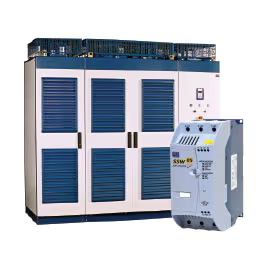
Selection foundation
A soft starter controls voltage during acceleration and deceleration but does not regulate motor speed during normal running. Selection therefore focuses on motor full-load current, load torque, required start time, starts per hour and thermal duty. Pumps may benefit from controlled stopping to reduce water hammer, while high-inertia loads can require more current capacity or a different starting method.
Select against the motor nameplate current and the manufacturer’s application table, including any ambient or enclosure derating.
Start time, initial torque, current limit, starts per hour and load inertia determine the thermal demand placed on the starter.
A bypass contactor reduces heat after acceleration. Confirm whether it is built in, separately supplied or controlled by the starter.
Review motor overload functions, phase protection, current monitoring, fieldbus options and the required start/stop interface.
Product range
These groups are a practical way to narrow the requirement. Final model selection still depends on the electrical, mechanical and installation data shown on this page.
Simple reduced-voltage starting for smaller motors with a focused control set and space-efficient installation.
Typical fit: Basic pumps, fans and light-duty machinery
Integrated bypass contactors reduce enclosure wiring and heat after the motor has completed acceleration.
Typical fit: Standard industrial starts with defined duty
Starter and bypass components are coordinated separately when the project standard, service strategy or current rating requires it.
Typical fit: Custom panels and project-specific protection schemes
Models with starting and stopping functions intended to improve pressure transitions in suitable pumping systems.
Typical fit: Water transfer, booster and process pumps
Higher thermal capacity and advanced control selected for long acceleration, frequent starts or difficult torque profiles.
Typical fit: Loaded conveyors, crushers and high-inertia equipment
Engineered systems for large motors where switching, insulation, protection and site coordination require a project review.
Typical fit: Large pumps, compressors, fans and mills
Quick selection
Select any available data. If the start duty is unknown, send the motor label and describe the driven equipment in WhatsApp.
Typical specification scope
Common applications
Controlled acceleration and pump-stop functions can limit pressure transients and mechanical stress in suitable systems.
A soft starter can reduce inrush and belt stress when continuous speed control and energy optimization are not needed.
The required breakaway torque, loaded start and acceleration time must be checked carefully before choosing the starter rating.
Unloaded-start arrangements, current limits and thermal capacity are reviewed to confirm whether a soft starter is appropriate.
Decision guide
From requirement to quotation
Provide motor current and voltage, starts per hour, start time and a short description of the driven equipment.
The required current, torque, bypass, protection and control functions are compared with manufacturer selection data.
The quotation identifies the starter rating, bypass basis, optional communication and any panel components included.
Frequently asked questions
A soft starter mainly controls acceleration and stopping, then the motor runs at line frequency. A VFD controls motor speed during operation. Use a VFD when process speed control or substantial variable-speed energy savings are required.
Some models include pump-control algorithms intended to improve starting and stopping transients. The result depends on the hydraulic system, so valve behavior, pipework and operating sequence still need engineering review.
Sometimes, but only when the manufacturer’s duty table covers the application, start time, starts per hour and ambient conditions. Heavy or frequent starts can require a larger starter.
Many starters use an internal or external bypass to reduce heat after the motor reaches speed. Confirm the model’s design and ensure that protection and control remain correct during bypass operation.
We include this page, your selected model or specifications, and a reference. You only add quantity and destination before sending.