
Technical guide
16 Variable Frequency Drive Manufacturers Compared: How to Shortlist a Brand
Compare 16 VFD manufacturers by drive range, controls, applications and support. This is a buyer shortlist, not a ranking, authorization or market-share claim.
Jack Dean writes practical VFD selection, wiring, replacement and power-quality guides using current manufacturer documentation and explicit procurement checks.
Author profile
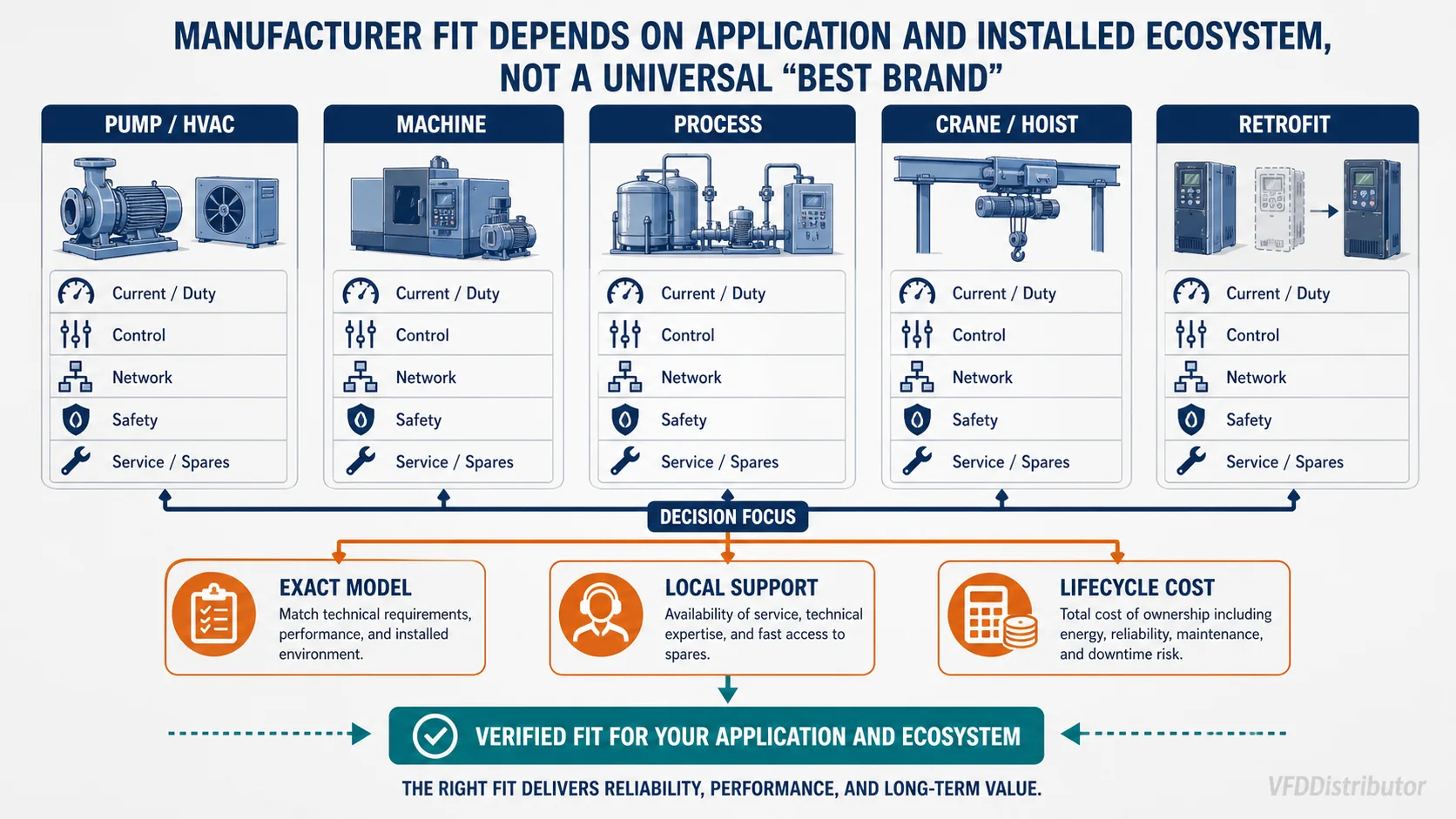
This shortlist covers 16 VFD manufacturers that regularly appear in industrial sourcing and replacement work: ABB, Siemens, Schneider Electric, Danfoss, Rockwell Automation, Yaskawa, Mitsubishi Electric, Fuji Electric, WEG, Delta Electronics, Eaton, Nidec Drives, Hitachi, Toshiba, Inovance, and INVT. There is no universally best brand: the right choice depends on motor current, load duty, control performance, PLC network, enclosure, harmonic limits, local support, and the expected service life of the machine. Inclusion is not an authorization, agency, partnership or market-share claim.
This guide compares sixteen established manufacturers from a buyer's point of view. It is a selection shortlist, not a claimed global market-share ranking. Product availability, certifications, firmware, and ratings vary by country and exact catalog number, so always verify the current manufacturer documentation before ordering. New buyers should first review what a VFD does and the nine-step VFD selection guide, because brand comparison only becomes useful after the application is defined.
VFD manufacturers compared at a glance
| Manufacturer | Representative drive families | Often shortlisted for | Ecosystem or integration advantage | Check before ordering |
|---|---|---|---|---|
| ABB | ACS180, ACS380, ACS580, ACS880 | General industry, process plants, pumps, fans, cranes | Broad common drive architecture and strong motor-control options | Duty rating, harmonic variant, enclosure, fieldbus option |
| Siemens | SINAMICS V20, G120C, G120, G120X, G220, S120 | Siemens-based factories, machines, infrastructure | TIA Portal, Startdrive, PROFINET, SIMATIC integration | Modular component compatibility, safety license/options, regional series |
| Schneider Electric | Altivar ATV320, ATV340, ATV600, ATV900 | Machinery, water, HVAC, process applications | EcoStruxure and Modicon integration | Application family, embedded services, network card, supply configuration |
| Danfoss | VLT FC 51/102/202/302, VACON, iC7 | HVAC, water, marine, process and OEM systems | Application-focused software and wide protocol support | Exact VLT/VACON/iC7 platform, approvals, filter and harmonic package |
| Rockwell Automation | PowerFlex 520 and 750 families | North American plants using Allen-Bradley controls | Studio 5000, Logix and EtherNet/IP integration | Regional stock, option modules, enclosure and replacement lifecycle |
| Yaskawa | GA500, GA501, GA800, FP605, U1000 | General machinery, demanding vector control, fans and pumps | Strong motor-control focus and practical commissioning tools | Normal/heavy-duty current, feedback, network option, successor model |
| Mitsubishi Electric | FREQROL FR-D, FR-E, FR-F, FR-A | Discrete manufacturing and Mitsubishi automation | MELSEC and CC-Link ecosystem integration | Region-specific model code, safety/network functions, legacy migration |
| Fuji Electric | FRENIC-Mini, FRENIC-Ace, FRENIC-MEGA, FRENIC-HVAC | OEM machines, compact panels and process machinery | Broad application families and flexible control functions | G1/G2 or E2/E3 generation, local support, option compatibility |
| WEG | CFW300, CFW500, CFW900, CFW11 | Motor-and-drive packages, pumps, machinery, heavy industry | One supplier for motors, drives and engineered packages | Motor/control mode, plug-in module, regional certification and service |
| Delta Electronics | MS300, C2000, CH2000, CP2000 | Cost-conscious OEMs and standard industrial automation | Delta PLC/HMI/servo ecosystem and multiple network choices | Local technical support, exact certification, built-in versus optional features |
| Eaton | PowerXL DG1, DM1, DE1, DA1 | Commercial systems, machinery, pumps and packaged equipment | Eaton power-distribution and control ecosystem | Regional series, bypass package, communications, service and lifecycle |
| Nidec Drives | Commander S, Unidrive M, F300, H300 | OEM machinery, high-performance control, HVAC and elevators | Scalable drive platforms and application-specific product lines | Current Nidec/Control Techniques naming, feedback, safety and migration path |
| Hitachi | SJ-P1, WJ-C1 and application-specific inverters | General machinery, conveyors, fans, pumps and compact panels | Practical industrial controls and compact inverter options | Regional availability, successor model, network option and local support |
| Toshiba | AS3, S15, Q9, P9 | Heavy-duty industry, HVAC, pumps and North American projects | Industrial motor and adjustable-speed-drive experience | Exact duty rating, enclosure, bypass, certification and replacement status |
| Inovance | General-purpose, high-performance and multi-drive platforms | Machinery, packaging, plastics and integrated automation | PLC, motion, servo and drive ecosystem | Regional product names, documentation, approvals and service coverage |
| INVT | GD20, GD200A, GD350, GD300 | Cost-sensitive machinery, pumps, fans and process equipment | Broad low-voltage portfolio with dedicated application ranges | Exact regional certification, firmware, support and option-card requirements |
Swipe or scroll horizontally to see all columns.
Quick interpretation: shortlist the manufacturer whose current drive family fits the application and the installed automation ecosystem. Then compare exact catalog numbers by output current, overload, ambient derating, I/O, communications, enclosure, safety, EMC, and lifecycle status. A familiar logo cannot compensate for a mismatched drive.
How we selected these manufacturers
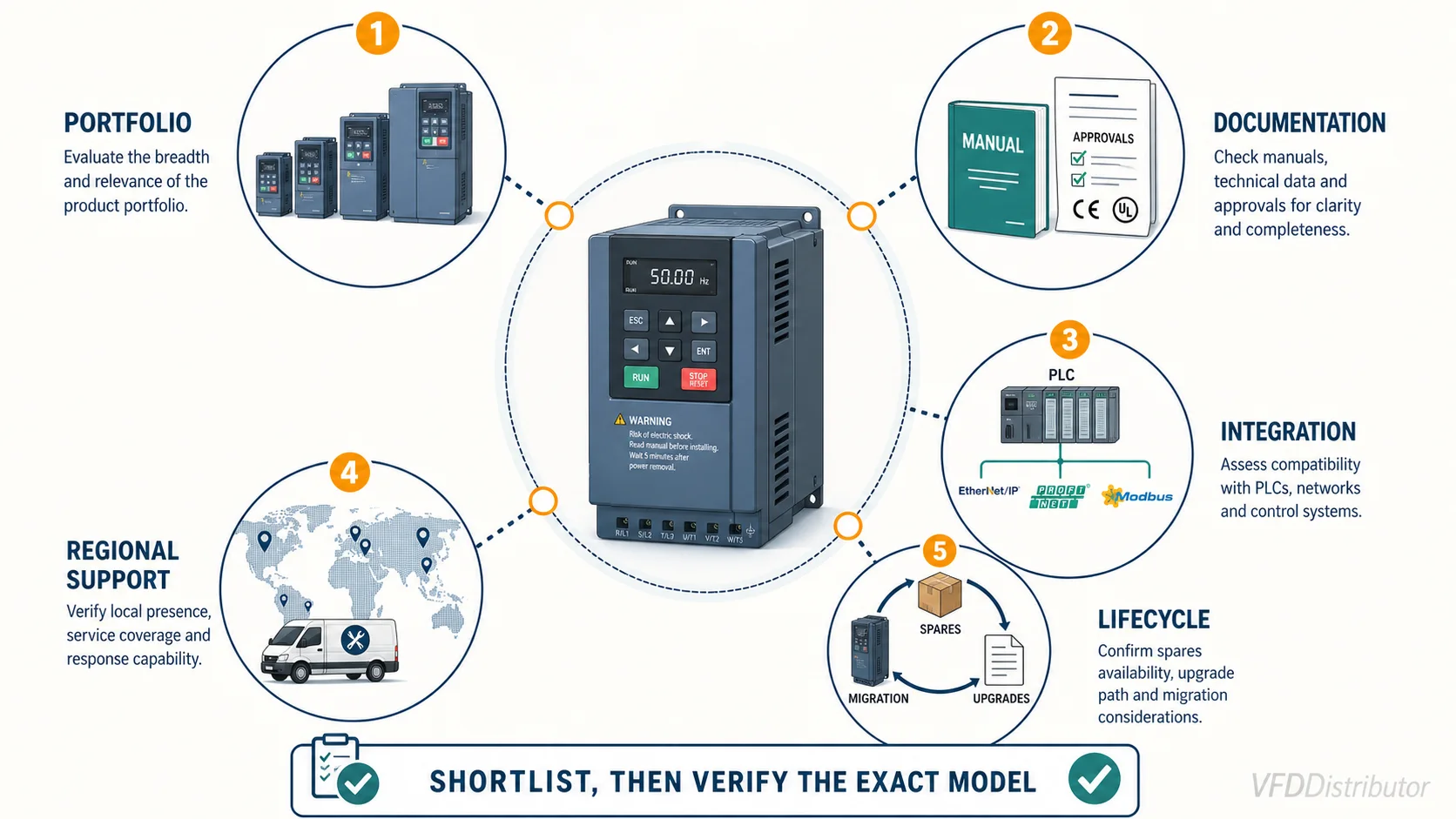
We reviewed the current drive portfolios published by the manufacturers and compared them against the questions that matter in real sourcing and replacement work:
- Does the portfolio cover common industrial VFD applications rather than one narrow niche?
- Are there distinct options for basic, general-purpose, application-specific, or high-performance duty?
- Can a buyer find current manuals, selection data, approvals, and lifecycle support?
- Does the manufacturer offer practical integration with common PLC and industrial network platforms?
- Is the brand relevant across more than one region or industry?
We did not assign invented reliability scores or claim precise global market shares. Reliability depends heavily on correct sizing, cabinet cooling, power quality, motor cable design, commissioning, preventive maintenance, and whether the selected model is appropriate for the load.
1. ABB

ABB is commonly shortlisted when a project needs a broad choice from compact machinery drives through general-purpose and high-performance industrial drives. Representative families include the ACS180 and ACS380 for machinery, the ACS580 for general-purpose duties, and the ACS880 for more demanding industrial control. ABB also offers application-focused ranges for HVAC and water.
Best fit: plants that want a consistent drive platform across pumps, fans, conveyors, mixers, cranes, and process equipment; projects that need low-harmonic or regenerative variants; and replacements where global documentation and service coverage matter.
Why buyers choose it: the range is wide, motor-control capability is strong, and related products often share familiar commissioning concepts. The ACS880 family is especially relevant where torque response, encoder feedback, coordinated drive systems, regenerative operation, or demanding duty is involved.
What to verify: “ACS” alone is not a specification. Confirm the full type code, supply voltage, continuous output current, normal- or heavy-duty rating, enclosure, EMC category, braking arrangement, fieldbus, safety options, and whether the application calls for a standard, regenerative, or ultra-low-harmonic unit. See the official ABB drives portfolio.
2. Siemens

Siemens SINAMICS drives are a natural candidate in plants already standardized on SIMATIC PLCs, PROFINET, TIA Portal, and Siemens engineering tools. The portfolio spans simple converters, modular general-purpose systems, infrastructure-focused drives, and high-performance motion platforms. Common names include V20, G120C, G120, G120X, G220, and S120, although availability and positioning vary by region.
Best fit: integrated Siemens automation projects, machine builders that value one engineering environment, pumps and fans using G120X, and more complex systems that need scalable control, safety, or motion functions.
Why buyers choose it: Startdrive and TIA Portal can reduce engineering friction when the PLC, HMI, safety system, and drive are designed as one automation platform. PROFINET diagnostics and standardized data structures are also valuable for plants with Siemens expertise.
What to verify: some SINAMICS platforms are modular, so the control unit, power module, operator panel, memory card, filters, and accessories must be compatible. Check whether required safety and communication functions are built in, licensed, or added by option. Review the official SINAMICS portfolio and the current regional catalog before final selection.
3. Schneider Electric
Schneider Electric organizes its Altivar portfolio around machine, process, and building applications. ATV320 and ATV340 products are associated with machinery, while the ATV600 range targets fluid-management loads such as pumps and fans and the ATV900 range addresses more demanding process and material-handling duties.
Best fit: OEM machines using Modicon automation, water and wastewater systems, HVAC, process plants, conveyors, cranes, and projects that want drive data connected into an EcoStruxure architecture.
Why buyers choose it: application-specific functions can reduce external control logic and commissioning work. The portfolio also extends from compact drives to engineered low- and medium-voltage systems, which can help standardize a multi-site specification.
What to verify: choose the Altivar family by load behavior, not by kW alone. Confirm whether web services, process monitoring, network communications, safety, dV/dt filtering, or harmonic mitigation are standard or optional in the exact configuration. The official Altivar overview provides the current family structure.
4. Danfoss

Danfoss has a long-established drives business with VLT, VACON, and the newer iC7 platform. Its product structure includes general automation drives and application-focused products for HVAC, water, refrigeration, marine, and other process duties.
Best fit: fan and pump systems, building services, water treatment, marine and offshore projects, OEM equipment, and applications that benefit from dedicated control functions rather than a generic parameter set.
Why buyers choose it: Danfoss combines motor control with deep application software, a broad protocol strategy, and products designed for several motor technologies. For variable-torque loads, dedicated functions such as sleep mode, multi-pump control, resonance avoidance, and condition monitoring can matter more than headline power rating.
What to verify: VLT, VACON, and iC7 are different platforms. Check exact software features, fieldbus hardware, EMC filter, line reactor, harmonic solution, coated boards, enclosure, and the class approval of the actual product variant when used at sea. Start with the official Danfoss Drives portfolio.
5. Rockwell Automation (Allen-Bradley)

Rockwell Automation's Allen-Bradley PowerFlex drives are a frequent specification in North American plants built around ControlLogix or CompactLogix. The PowerFlex 520 family covers many machine-level applications, while the 750 family addresses larger and more demanding industrial systems.
Best fit: facilities with established Rockwell standards, EtherNet/IP networks, Studio 5000 engineering workflows, and maintenance teams trained on Allen-Bradley hardware.
Why buyers choose it: Premier Integration can simplify drive profiles, parameter access, diagnostics, and replacement within a Logix project. In a standardized plant, reduced engineering and maintenance time may outweigh a lower purchase price from an unfamiliar platform.
What to verify: identify the exact PowerFlex series, frame, voltage, duty rating, communication hardware, safety functions, enclosure, and option bay requirements. For legacy replacements, confirm the mechanical footprint, I/O behavior, network adapter, and parameter-conversion path. See the official PowerFlex VFD overview.
6. Yaskawa

Yaskawa is strongly associated with AC motor control and motion technology. Its current industrial lineup includes GA500 and GA501 microdrives, the GA800 general-purpose vector drive, FP605 fan and pump products, and U1000 matrix drives for low-harmonic regenerative applications.
Best fit: machinery that needs dependable open- or closed-loop vector control, conveyors, mixers, extruders, test systems, and standard fan or pump installations.
Why buyers choose it: the portfolio is focused and the commissioning tools are practical. GA800 supports multiple control modes and network options, while GA500 provides capable motor control in a compact package. Application-specific families avoid paying for features that will not be used.
What to verify: compare the drive's rated output current at the required normal- or heavy-duty setting. Check braking, encoder feedback, STO level, network option, enclosure, and whether a legacy A1000 or V1000 should migrate to a current GA-series product. Use the official Yaskawa industrial AC drive list to confirm the active family.
7. Mitsubishi Electric

Mitsubishi Electric's FREQROL family is widely used in discrete manufacturing and machinery. The lineup includes compact FR-D products, flexible FR-E drives, fan-and-pump-oriented FR-F products, and high-performance FR-A drives.
Best fit: machines already using MELSEC PLCs, Mitsubishi HMIs or servos, packaging and material handling, and applications where compact installation and factory-automation network integration are priorities.
Why buyers choose it: the drive can fit cleanly into a Mitsubishi automation architecture, while the different FREQROL families allow buyers to separate simple, variable-torque, and high-performance requirements. The FR-A800 family, for example, provides sensorless and encoder-based vector-control options for more demanding machinery.
What to verify: Mitsubishi model codes and standard features vary by sales region. Confirm voltage class, output current, control mode, safety functions, built-in or optional network support, EMC requirements, and the recommended successor for discontinued FR models. Review the official FREQROL product range.
8. Fuji Electric

Fuji Electric's FRENIC lineup covers compact, general-purpose, high-performance, HVAC, water, lift, and specialized applications. FRENIC-Mini, FRENIC-Ace, and FRENIC-MEGA are common reference points, with product generations identified by suffixes such as E2, E3, G1, or G2.
Best fit: compact OEM panels, machine tools, conveyors, compressors, process equipment, and buyers who need a broad range without leaving one drive family.
Why buyers choose it: FRENIC products combine multiple motor-control modes with customizable logic, network options, maintenance diagnostics, and application-specific variants. This can be useful when panel space and external PLC logic are limited.
What to verify: do not treat “FRENIC-MEGA” or “FRENIC-Ace” as a complete model. Confirm generation, regional suffix, duty rating, voltage, braking hardware, safety, feedback, fieldbus, and parameter-migration method from the installed unit. The official Fuji Electric low-voltage drive portfolio lists current and discontinued families.
9. WEG

WEG manufactures motors as well as variable speed drives, which makes it attractive for projects seeking a coordinated motor-and-drive package. The range includes compact CFW300 drives, flexible CFW500 products, and higher-performance CFW900 and CFW11 systems.
Best fit: pumps, fans, conveyors, machinery, processing equipment, heavy industry, and projects where one supplier is expected to support both the motor and the drive package.
Why buyers choose it: coordinated motor and VFD selection can simplify responsibility for compatibility, efficiency, and application engineering. CFW500 offers several control modes and plug-in modules, while CFW900 targets precise speed, torque, and position control for induction and permanent-magnet motors.
What to verify: a motor-and-drive package still requires a current-based selection. Confirm the motor technology, overload duty, plug-in module, safety functions, enclosure, braking, network, and certifications required at the destination. See the official WEG variable speed drive portfolio.
10. Delta Electronics

Delta Electronics offers a wide industrial automation portfolio that includes PLCs, HMIs, servos, and AC motor drives. Its VFD families include compact products such as MS300, high-performance C2000 drives, heavy-duty CH2000 products, and CP2000 drives for fans, pumps, and HVAC.
Best fit: cost-conscious OEM machinery, Delta-based automation systems, standard conveyors, pumps and fans, and export equipment where the required model has appropriate regional approvals and support.
Why buyers choose it: the specification-to-price balance can be attractive, and integration with other Delta automation products can reduce engineering effort. The C2000 platform supports several motor-control modes and network options for applications beyond simple V/f control.
What to verify: compare the exact built-in functions against the option cards and external components required to match another brand. Confirm local technical support, firmware, certification, documentation language, replacement stock, enclosure, braking, EMC, and the full model code. Review the official Delta C2000 product information as one reference point within the wider Delta range.
11. Eaton

Eaton's PowerXL portfolio covers compact speed starters, general-purpose VFDs, and engineered drive or bypass packages. Product names such as DE1, DA1, DM1, and DG1 appear across different regions and application levels, with larger systems available for commercial and industrial facilities.
Best fit: pump and fan packages, building services, material handling, machinery, and sites that already use Eaton power distribution, motor control, and protection products.
Why buyers choose it: coordinating the VFD with breakers, disconnects, contactors, bypass hardware, and power-distribution equipment can simplify a packaged specification. Eaton also offers enclosed configurations suited to installations that do not want to engineer a drive panel from separate parts.
What to verify: PowerXL names and availability differ by region. Confirm the input and output current, overload class, enclosure, bypass arrangement, short-circuit rating, network support, filter package, and whether local service supports the selected series. Start with the official Eaton PowerXL DG1 information.
12. Nidec Drives

Nidec Drives is the current brand home for a drive portfolio long associated with Control Techniques. Its ranges include compact Commander products, general and high-performance Unidrive platforms, and application-focused F300 and H300 drives for fans, pumps, and HVAC.
Best fit: OEM machinery, high-dynamic motor control, test equipment, fans and pumps, elevators, and legacy Control Techniques installations that need a supported migration path.
Why buyers choose it: the portfolio scales from simple open-loop control to encoder-based and servo-capable systems. Flexible application programming and feedback options can reduce external control hardware in specialized machines.
What to verify: confirm whether project documents use the Control Techniques or Nidec Drives name, then match the exact current family, firmware, option modules, feedback devices, safety functions, keypad, and parameter conversion. The official Nidec general-purpose drive portfolio is the current starting point for product and support information.
13. Hitachi

Hitachi Industrial Equipment Systems supplies compact and general-purpose inverters for industrial machinery. Families such as SJ-P1 and compact WJ-series products are often encountered in conveyors, pumps, fans, mixers, and factory equipment, especially in Asian markets and installed legacy fleets.
Best fit: general machinery, compact control panels, material handling, pump and fan systems, and replacements where a Hitachi inverter is already integrated into the machine.
Why buyers choose it: the range combines practical motor-control functions with compact packaging and established industrial-equipment support. For an installed machine, preserving familiar I/O behavior and parameter concepts may reduce conversion risk.
What to verify: regional catalogs and successor models can differ. Confirm the complete model code, current and overload rating, braking transistor, safety function, fieldbus option, keypad compatibility, enclosure, and local availability. Use the official Hitachi Industrial Equipment Systems product portal to locate current regional information.
14. Toshiba

Toshiba International supplies adjustable-speed drives for compact machinery, HVAC, pumps, and demanding industrial systems. Common North American reference families include the AS3 general-purpose drive, S15 microdrive, Q9 HVAC drive, and P9 pump drive, alongside larger engineered drive systems.
Best fit: water and wastewater, HVAC, material handling, processing plants, and facilities that value coordinated Toshiba motor and drive application support.
Why buyers choose it: application-specific pump and HVAC products can provide useful process functions and packaged bypass options, while the AS3 platform covers broader industrial control requirements.
What to verify: check the exact duty rating, enclosure, bypass and disconnect configuration, communications, embedded safety, harmonic or filter requirements, and whether the catalog family is active in the destination market. See the official Toshiba AS3 adjustable-speed drive page.
15. Inovance

Inovance has grown from an AC-drive supplier into a wider industrial-automation manufacturer covering drives, PLCs, motion controllers, servos, HMIs, and industrial robots. Its VFD offering spans compact machinery drives, higher-performance products, and multi-drive systems for coordinated production equipment.
Best fit: packaging, plastics, textiles, printing, material handling, and machines that combine VFDs with Inovance PLC, motion, or servo products.
Why buyers choose it: a broad automation ecosystem can be attractive to machine builders seeking integrated control at a competitive installed cost. Multi-axis and common-DC-bus architectures are also relevant where several motors must coordinate and share regenerative energy.
What to verify: product names, approvals, manuals, firmware, and distribution coverage differ across China, Europe, and other export markets. Confirm the exact regional series, motor compatibility, network support, safety, option cards, and after-sales channel through the official Inovance product portal.
16. INVT

INVT offers a broad low-voltage VFD range that includes compact GD20 drives, general-purpose GD200A products, higher-performance GD350 units, and application-specific platforms. The company also supplies medium-voltage drives, servo systems, PLCs, and related industrial-automation products.
Best fit: pumps, fans, conveyors, compressors, machine tools, process equipment, and cost-sensitive OEM projects where qualified local engineering support is available.
Why buyers choose it: the range covers many common power and application levels with several dedicated variants. This can provide a competitive option when the exact product has the required approvals, network interfaces, and regional support.
What to verify: compare continuous current and overload data rather than matching only kW. Confirm firmware, documentation language, EMC and safety compliance, option cards, spare availability, warranty channel, and certification for the destination. Review the official INVT VFD portfolio and the exact product manual before ordering.
Which VFD brand is best for each application?
The table below is a starting point, not a substitute for engineering. More than one manufacturer can serve each application well.
| Application or project condition | Manufacturers often considered | Why they enter the shortlist |
|---|---|---|
| Siemens PLC and PROFINET factory | Siemens; also ABB, Danfoss, Yaskawa, or others with the correct PROFINET option | Native engineering workflow favors Siemens, but open networks preserve alternatives |
| Allen-Bradley Logix plant | Rockwell Automation; alternatives with validated EtherNet/IP profiles | Existing code, spare parts, and technician familiarity can dominate lifecycle cost |
| HVAC fans and building services | Danfoss, ABB, Schneider Electric, Siemens, Eaton, Toshiba, Nidec, Delta | Dedicated fan, PID, bypass, sleep, fire-mode, and BMS features are widely available |
| Water and wastewater pumps | Danfoss, Schneider Electric, ABB, Siemens, Yaskawa, WEG, Toshiba, Eaton | Pump staging, dry-run protection, pipe-fill, sleep, and process monitoring can reduce external controls |
| Conveyors, mixers, extruders | ABB, Yaskawa, Siemens, Schneider Electric, Mitsubishi, Fuji, Hitachi, Nidec | Constant-torque overload, vector control, braking, and feedback options are central |
| Cranes, hoists, test stands | ABB, Yaskawa, Siemens, Schneider Electric, Danfoss, Nidec | Braking control, torque proving, encoder feedback, regeneration, and functional safety need application review |
| Coordinated motor-and-drive package | WEG, ABB, Siemens, Mitsubishi Electric, Toshiba | One supplier can help align motor data, efficiency, control, and mechanical interfaces |
| Cost-sensitive OEM machine | Delta, Mitsubishi, Fuji, Yaskawa, Inovance, INVT | Compact drives and automation ecosystems can deliver strong installed value when local support is available |
| Marine or offshore system | Only products with the exact required class/type approval | Approval belongs to a specific product and configuration, not to every drive made by the brand |
Swipe or scroll horizontally to see all columns.
If the project only needs reduced starting current and the motor will run at full speed, compare a soft starter rather than assuming a VFD is necessary. If continuous speed or torque control is required, start with our variable frequency drive selection guide.
Seven checks for choosing a VFD manufacturer
1. Start with the load, not the logo
A centrifugal fan has different overload and braking needs from a loaded conveyor, crusher, hoist, or positive-displacement pump. Define variable-torque or constant-torque duty, starting torque, speed range, acceleration time, deceleration energy, reversals, and operating cycle before comparing drive families.
2. Size by motor current and duty rating
Motor kW or horsepower is only the first filter. Compare the motor nameplate full-load current with the VFD's continuous output current at the required voltage, carrier frequency, ambient temperature, altitude, and overload class. A nominal 22 kW drive may not be suitable for every 22 kW motor or every heavy-duty load.
For a new motor-drive package, review the industrial motor selection factors at the same time. Permanent-magnet and synchronous-reluctance motors also require confirmed control compatibility.
3. Match the automation network
List the required protocols and profiles: PROFINET, EtherNet/IP, Modbus TCP, Modbus RTU, PROFIBUS, EtherCAT, CANopen, BACnet, or another network. Then determine whether the interface is built in or requires a card, license, gateway, or different control-unit version. Obtain the EDS, GSDML, or other integration file before commissioning day.
4. Design for the real environment
Check temperature, altitude, dust, moisture, corrosive gases, washdown, vibration, cable length, and installation clearances. An IP20 drive mounted correctly in a cooled VFD panel can be a better solution than an enclosed drive installed without adequate thermal design. Also check conformal coating and pollution-degree requirements where applicable.
5. Treat harmonics and EMC as system questions
Line reactors, DC chokes, passive filters, active filters, multi-pulse systems, and active-front-end drives solve different problems. The correct choice depends on the point of common coupling, source impedance, other loads, regeneration, and the applicable standard. Review the complete power quality solution and the guide to VFD harmonics and line reactors, not a single brochure THDi number.
Motor-side issues matter too. Long cables and fast PWM voltage edges may require an output reactor, dV/dt filter, sine-wave filter, inverter-duty motor, insulated bearing, or shaft-grounding solution.
6. Check lifecycle and replacement support
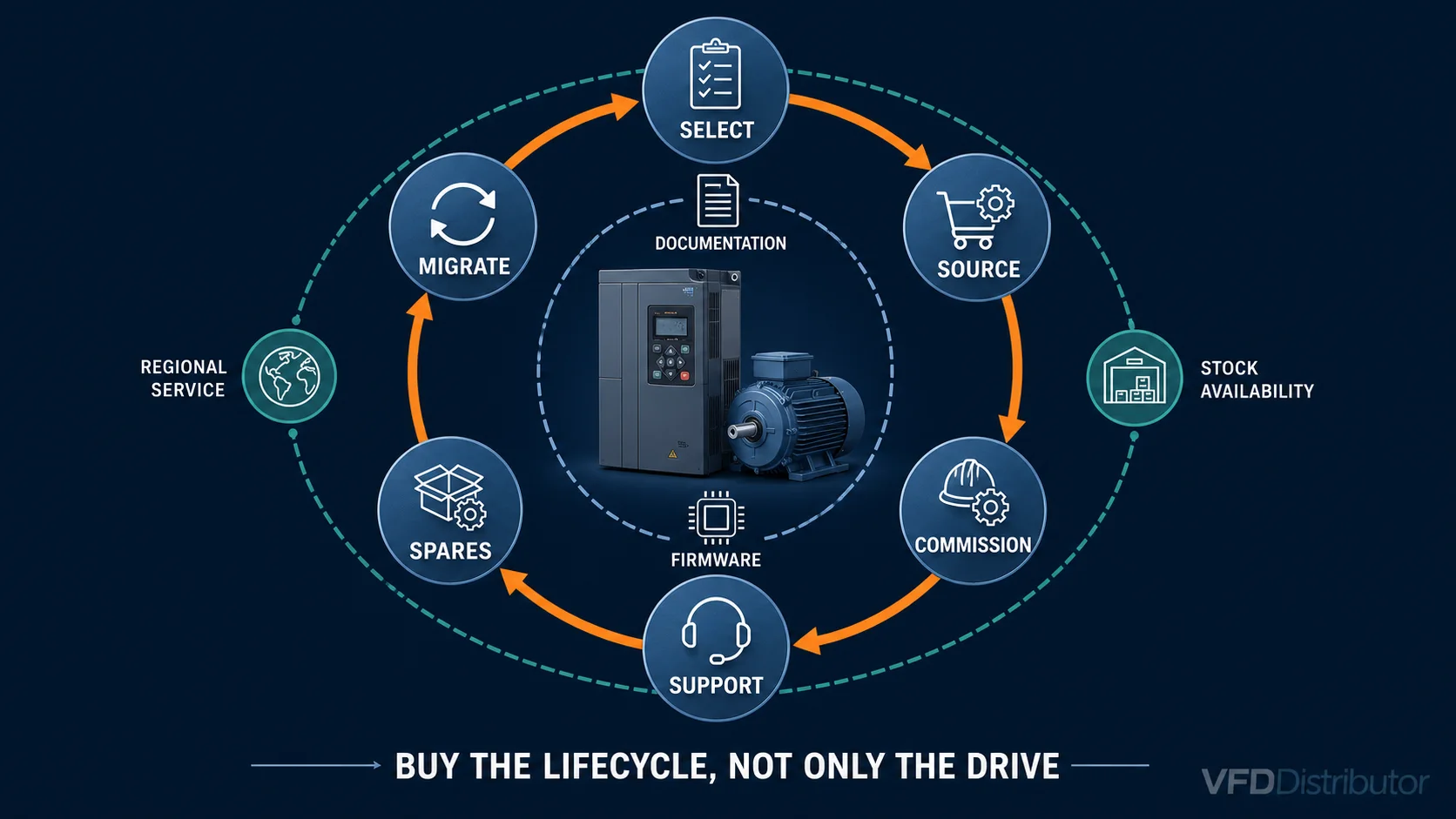
Ask for the product lifecycle status, warranty route, local repair capability, spare fans and keypads, firmware policy, manuals, parameter backup method, and announced successor. A slightly higher purchase price can be economical if the exact drive is stocked locally and technicians already know how to commission it.
7. Compare total installed cost
Include the drive, option cards, keypad, filters, reactors, braking resistor, bypass, disconnect, enclosure, cooling, fuses, engineering time, software, commissioning, spares, and downtime risk—and audit competing supplier proposals against our VFD installation cost quote checklist before comparing prices. The least expensive base drive is not necessarily the least expensive operating solution.
Replacing a VFD with another manufacturer
A cross-brand replacement is possible, but it is an engineering change rather than a simple part-number swap. Follow the full VFD replacement checklist, record the installed drive's complete nameplate and parameter backup, then compare:
- input voltage, phase, frequency, and short-circuit rating;
- motor current, motor type, base frequency, speed, and feedback device;
- continuous output current and overload curve;
- braking transistor, resistor, DC-bus, or regenerative arrangement;
- digital and analog I/O logic, signal ranges, relays, and thermistor input;
- fieldbus protocol, telegram/profile, node settings, and PLC data mapping;
- safe torque off and any other functional-safety requirements;
- enclosure, dimensions, mounting, ventilation, heat loss, and terminal locations;
- motor-cable length, EMC category, grounding, and required filters;
- application functions such as PID, flying start, torque proving, multi-pump control, or fire mode.
For critical machinery, test the replacement under actual load and document the revised drawings, parameters, safety validation, spares, and recovery procedure. Recheck the migrated power and control circuits against the VFD wiring guide. VFDDistributor.com supports exact-model sourcing and cross-brand matching, but final approval should remain with the responsible engineer or equipment owner.
Common mistakes when comparing VFD brands
- Ranking brands by reputation alone. A well-known manufacturer can still be the wrong choice if the selected family lacks the required overload, network, enclosure, or local support.
- Comparing only kW or horsepower. Output current, overload curve, derating, and motor type determine whether the drive can carry the load.
- Assuming every feature is built in. Network, encoder, safety, braking, EMC, and harmonic functions may require different hardware.
- Treating IP rating as thermal design. A sealed enclosure protects against contamination but still needs a heat-removal strategy.
- Assuming all products from a marine brand are approved. Type approvals apply to specific models, ratings, firmware, options, and installation conditions.
- Ignoring lifecycle status. A cheap legacy drive may create the next downtime problem if keypads, boards, or replacement units are no longer supported.
- Changing brands without reviewing PLC logic. Control words, status words, scaling, fault handling, safety behavior, and restart logic may differ even on the same network.
Frequently asked questions
For the next step in product research, use our VFD selection and sourcing guide, browse the VFD model catalog, compare engineered VFD control panels, review compatible industrial motors, decide whether a soft starter is sufficient, and plan any required power-quality equipment.
Which VFD manufacturers appear on this shortlist?
ABB, Siemens, Schneider Electric, Danfoss, Rockwell Automation, Yaskawa, Mitsubishi Electric, Fuji Electric, WEG, Delta Electronics, Eaton, Nidec Drives, Hitachi, Toshiba, Inovance, and INVT are the 16 brands reviewed here. The right choice still depends on the exact application, region, automation platform, approvals, and service requirements.
Which VFD manufacturer is the most reliable?
There is no defensible universal winner. Field reliability depends on selecting the correct drive family and rating, controlling heat and contamination, protecting against line and motor-side electrical stress, commissioning correctly, and maintaining cooling components. Local service and spare availability also affect real uptime.
Can I use a different brand of VFD with my motor?
Usually yes, provided the new drive supports the motor type and matches its voltage, current, frequency, speed range, feedback, and thermal requirements. Check application overload, braking, cable length, filters, I/O, network mapping, and safety functions before approving a cross-brand replacement.
Should the VFD be larger than the motor?
Not automatically. Select the VFD by rated output current, required overload duty, ambient derating, carrier-frequency derating, and the manufacturer's application rules. Oversizing can be appropriate in some conditions, but unnecessary oversizing increases cost and may create protection or tuning issues.
Is a premium VFD brand worth the cost?
It can be when the premium buys shorter commissioning, native PLC integration, local stock, proven application software, service access, or reduced downtime. For a simple standalone pump, a lower-cost drive with correct ratings and competent support may deliver better value. Compare total installed and lifecycle cost.
What information is needed for a VFD quotation?
Provide the existing model number if it is a replacement. Also send the motor nameplate, supply voltage and phase, application/load, required speed range, normal or heavy duty, enclosure, ambient conditions, communications, I/O, braking, cable length, certifications, quantity, and delivery destination.
Final recommendation
The best VFD manufacturer for a project is the one that offers the right active product family, correct electrical and overload rating, required controls and approvals, dependable regional support, and an acceptable lifecycle cost. Use brand reputation to build a shortlist, then make the purchase decision at the exact-model level.
If you are comparing several brands or replacing an obsolete drive, send us the full model number, motor nameplate, application, voltage, and destination. We can help identify an exact replacement or build a cross-brand shortlist through our multi-brand VFD selection and supply service.
Editorial method and disclosure: This comparison was reviewed on 3 September 2026 against the official manufacturer portfolio pages linked in each section. It is not a paid ranking, and inclusion does not mean authorization, agency, stock, certification or that every product from a manufacturer is suitable for every application. We review the guide when major product families or lifecycle information change. Brand logos are trademarks of their respective owners and are displayed only to identify the manufacturers discussed.