
Technical guide
VFD vs Soft Starter: Industrial Motor Control Guide
Compare VFD vs soft starter architectures across starting torque, inrush current, bypass losses, pump and fan affinity laws, duty classes, and panel wiring.
Jack Dean writes practical VFD selection, wiring, replacement and power-quality guides using current manufacturer documentation and explicit procurement checks.
Author profileChoosing between a variable frequency drive and a solid-state soft starter is a foundational motor control decision for pumps, fans, compressors, conveyors, crushers, and mixers. While both solid-state controllers tame mechanical shock and electrical inrush during motor acceleration, their power conversion topologies, breakaway torque profiles, full-speed thermal losses, and variable-flow energy economics differ fundamentally.
According to ABB, nearly 70 percent of all industrial electrical energy use goes to powering electric motors.
According to LS Electric America, motor-driven systems account for nearly 40% of global electricity consumption.
In Control Global's comparison of soft starters and VFDs, Yaskawa application engineer Scott Richardson notes that both soft starters and VFDs can reduce inrush currents and machine starting torque by 30% to 75% compared to an across-the-line starter, while AutomationDirect product manager Joe Kimbrell states that a soft starter is generally around 99.5% efficient whereas a VFD is usually about 95% to 97% efficient.
According to WEG, variable frequency drives can provide energy savings of up to 50 percent over the life of the equipment, while initially costing two to three times more than a soft starter.
This guide from the VFDDistributor Learning Center compares soft starter vs VFD power stage topologies, starting current and torque behavior, affinity-law energy payback, thermal duty sizing, inside-delta wiring, and short-circuit coordination so plant engineers and panel builders can specify the right architecture for each motor circuit.
Power Circuit Topology: Thyristor Voltage Ramp vs Pulse Width Modulated Frequency Conversion
A soft starter and a variable frequency drive control three-phase induction motors through completely different semiconductor architectures. A thyristor soft starter adjusts root-mean-square voltage only during acceleration and deceleration while line frequency remains fixed, whereas a frequency converter rectifies incoming alternating current onto a direct-current bus and synthesizes variable voltage and variable frequency across the entire operating profile.
IEC 60947-4-2:2020 applies to semiconductor motor controllers, starters and soft-starters, which can include a series mechanical switching device, intended to be connected to circuits whose rated voltage does not exceed 1 000 V AC.
Amendment 1 to IEC 60947-4-2:2020 (IEC 60947-4-2:2020/AMD1:2024) has a corrected version dated 2026-03 that includes the content of Corrigendum 1 (2026-03).
Softstarter standards listed in the ABB Softstarter Handbook include EN 60947-1, IEC 60947-4-2, EN 60947-4-2, UL 508, CSA C22.2 No. 14, and GB14048.6-2008.
For softstarters, normal operational voltage (Ue) values are 200 - 690 V AC, common control circuit voltage (Uc) values are 24 V DC or 110 - 240 V AC, and a common control supply voltage (Us) value is 100 - 250 V AC.
Traditionally, a three-phase controlled softstarter uses 6 thyristors (two anti-parallel connected in each of the 3 phases) to control output voltage, whereas a 2-phase controlled softstarter controls only 2 of the 3 phases while the third phase passes through uncontrolled.
All types of ABB softstarters can be used at both 50 and 60 Hz supply frequencies as long as the voltage waveform curve is sinusoidal.
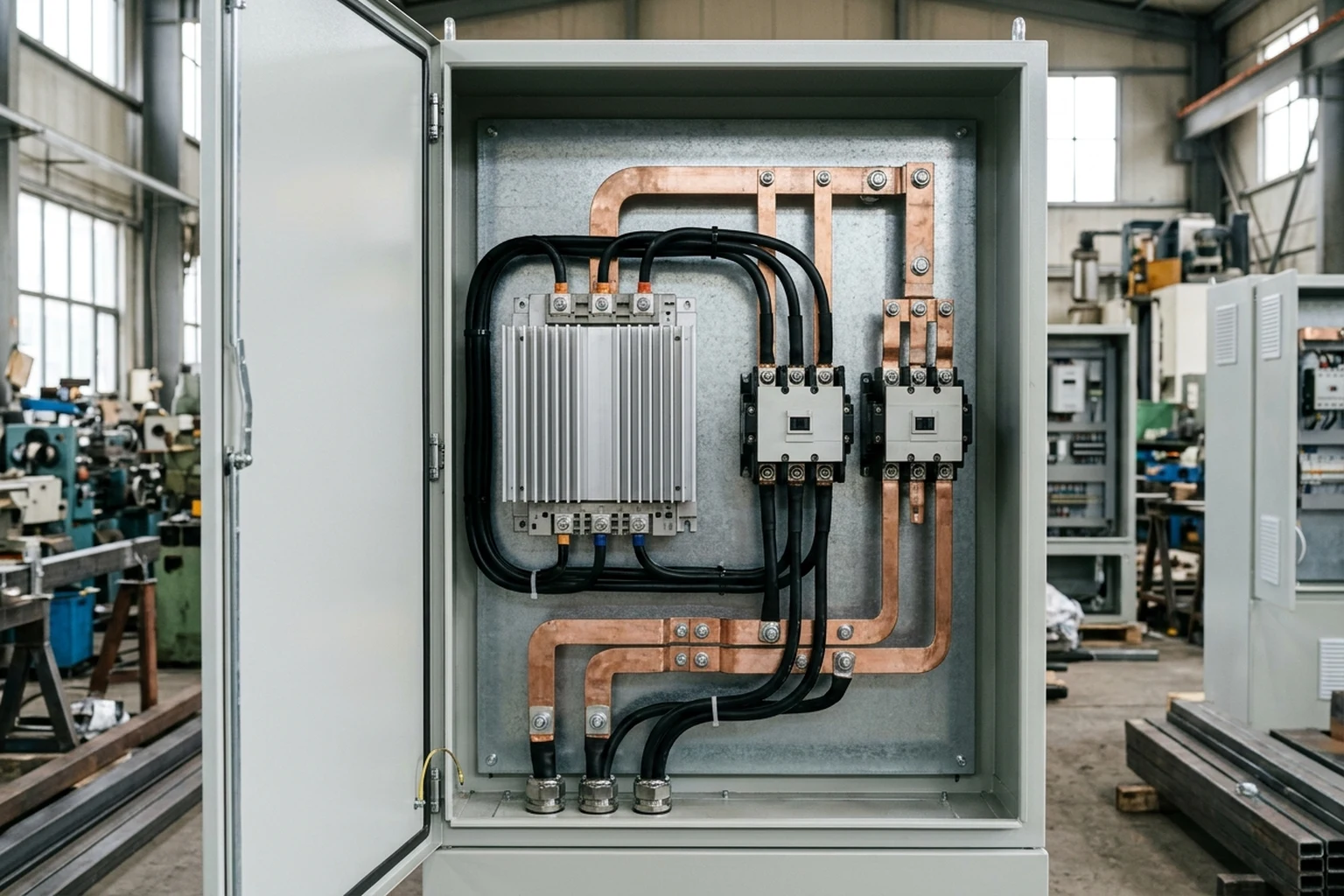
Open motor control cabinet showing an unbranded thyristor soft starter mounted alongside a line contactor and an external bypass contactor interconnected by copper busbars.
Commercial soft starter families span compact rail-mounted starters, heavy-duty industrial frames, and medium-voltage lineups.
LS Electric specifies three soft starter product ranges by voltage and current: LV SSC Series (200–575Vac, 18–200A), LV SSM Series (200–690Vac, 24–1250A), and LV SSH Series (2.3–13.8kVac, 70–1700A).
Schneider Electric Altivar ATS130 soft motor starters are designed for simple machines from 11kw to 55kw in the same width (55mm or 81mm) as direct-on-line (DOL) starters with DIN rail mounting and spring terminals.
Schneider Electric ATS430 Altivar soft starters are designed for standard industrial machines ranging from 4kw to 400kw and include cybersecurity and condition monitoring features.
AutomationDirect Stellar SR44 series solid-state soft starters use thyristors in all three motor phases with 115 or 230 VAC selectable control voltage and are UL listed, CE, REACH, and RoHS approved.
By contrast, a variable frequency drive decouples motor speed from utility line frequency through a three-stage converter structure.
A frequency converter (VSD/VFD) converts AC (50 or 60 Hz) to DC and converts the DC back to AC with a variable frequency of 0-250 Hz to control motor speed.
In WEG's VFD main circuit architecture, AC supply power from the facility network (typically 208V, 230V, 480V, 575V, 690V / 60 Hz AC) is rectified to DC, smoothed by chokes and the DC bus, and inverted to sine-like AC using pulse width modulation (PWM).
In a three-phase VFD inverter section, six Insulated Gate Bipolar Transistors (IGBTs) switch at a Pulse Width Modulation (PWM) frequency usually between 4 and 16kHz, operating at DC link voltages from 300V (with a 230V AC input) up to 600 - 900V with industrial three-phase supplies.
The synchronous speed N (in rpm) of an AC induction motor is determined by the applied frequency f (in Hz) and number of motor poles p according to the equation N = 120f / p.
Because a rectifier and pulsed inverter draw non-sinusoidal input current and switch fast voltage pulses on the motor leads, engineers designing drive lineups should also evaluate VFD harmonics and line reactors along with dedicated power quality products.
Starting Current, Breakaway Torque, and Star-Delta Alternatives
Understanding the vfd vs soft starter distinction during acceleration requires comparing how reduced voltage affects induction motor flux and shaft torque against across-the-line and star-delta starting methods.
During a direct-on-line motor start, the start current is between 6 to 8 times the rated motor current, values of up to 14 times rated current exist, and the magnetization peak can be over 20 times the rated current.
When starting direct-on-line (DOL), starting current is typically 7-8 times the nominal current, and when using a softstarter it is reduced to 3-5 times the nominal current.
In a star-delta starter, the voltage across each motor winding is 1/√3 of the main voltage, reducing torque with the square of the voltage to a theoretical value of 33% and a more true value of 25% of delta-connected torque.
When starting a pump with a star-delta starter, the quadratic load torque becomes too high for the star-connected motor at approximately 80-85% of the rated speed, requiring a switch-over to delta connection with a 50 ms delay between opening the star contactor and closing the delta contactor.
During star-delta open-transition switching, the potential difference between the network and the motor magnetic field can reach twice the network voltage, reacting up to 800V in a 400V network and creating current and torque spikes.
A solid-state soft starter eliminates the open-transition switching spike of a star-delta starter by ramping voltage smoothly through thyristor firing angles, but it remains bound by the quadratic relationship between stator terminal voltage and shaft torque.
With a softstarter, if the voltage is decreased to 50% of the full voltage, the current decreases to about 50% of the maximum current at that speed and the torque decreases to about 25% of the maximum torque.
Because motor torque decreases with the square of the voltage, if a softstarter's initial voltage is set too low at 20 %, the starting torque becomes 0.04 = 4 % only.
Consequently, a soft starter cannot start a loaded conveyor, positive-displacement pump, or crusher if reducing the inrush current pulls terminal voltage below the breakaway torque demanded by the driven shaft. A variable frequency drive avoids this voltage-squared torque penalty by regulating both voltage and frequency to maintain stator magnetic flux from standstill.
With a frequency converter, rated motor torque is available already from start at around the nominal current, and the drive usually trips if the current reaches 1.5 times the rated current.
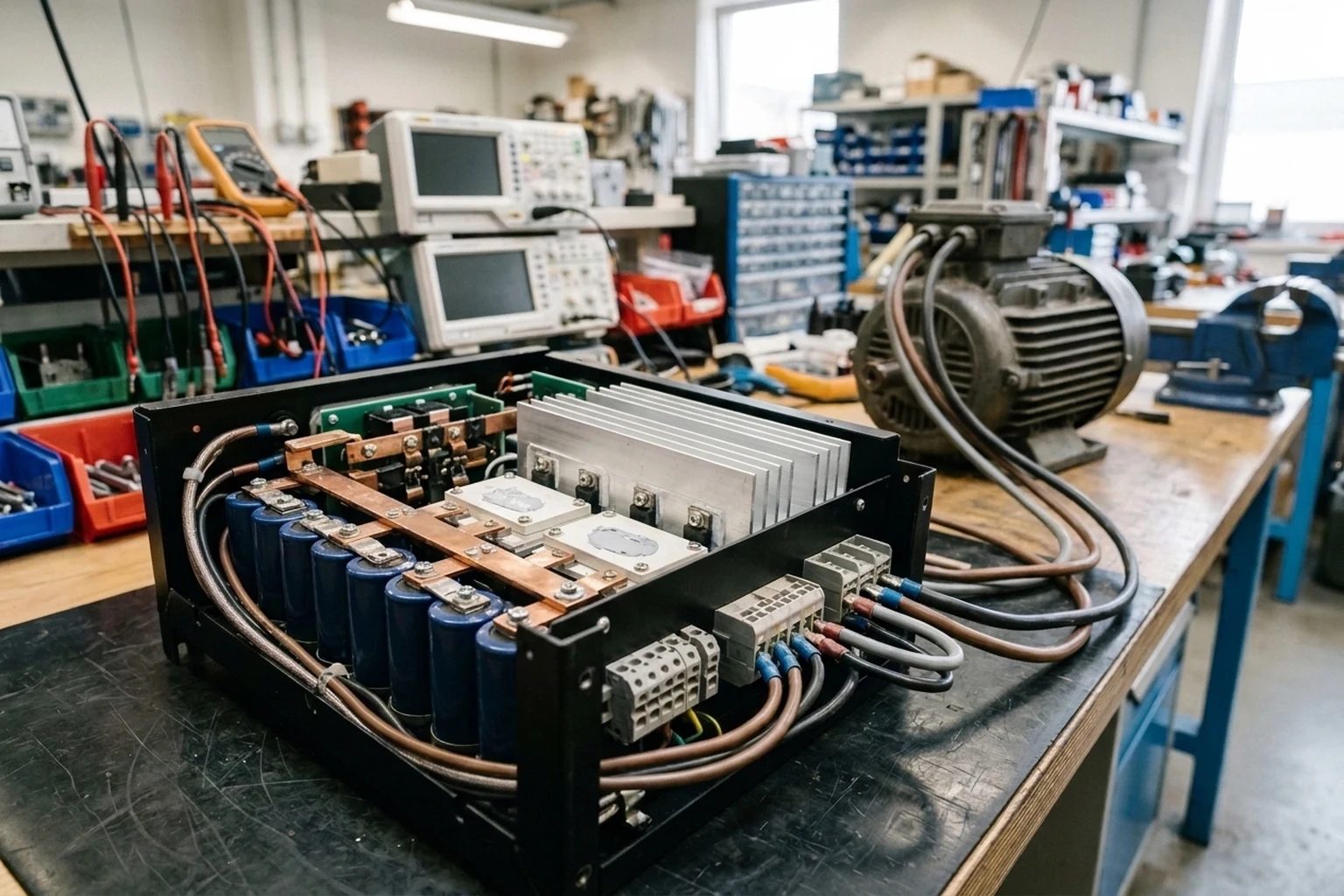
Variable frequency drive power stage showing the input rectifier bridge, copper busbars, electrolytic link capacitors, and transistor heatsink connected to an induction motor.
Running Efficiency, Affinity Laws, and Total Cost of Ownership
Once the motor reaches full speed, the economic comparison shifts from breakaway torque to continuous thermal dissipation, process speed modulation, and capital cost. When a motor runs continuously at full utility speed without throttling flow or varying shaft speed, a soft starter with a closed bypass contactor introduces almost zero semiconductor switching loss.
Utilization category AC-53a designates control of squirrel-cage motors in 8 h duty with on-load currents for start, acceleration, and run (softstarter designed for use without an external bypass contactor), whereas AC-53b designates intermittent duty (softstarter designed for use with an external bypass contactor).
For ABB PST30...300 softstarters, total continuous power loss without bypass is PLtot = [3 x Ie x 1.0] + 50 (W), which is reduced to 50 W only when using a bypass contactor.
In ABB's Guide to Variable Speed Drives, transistor-based frequency converter efficiency is from 0.97 to 0.99, motor efficiency is typically between 0.82 and 0.97 depending on motor size and rated speed, and total drive system efficiency is always above 0.8.
Upfront hardware and installation budgets also diverge sharply as motor power increases on fixed-speed machinery.
In ABB's comparison table of starting methods (Direct on line, Star-Delta start, Drives, Softstarter), the estimated average installation cost index is 1 for Direct on line, 3 for Star-Delta, > 12 for Drives, and 6 for Softstarter.
In Control Global's size and cost comparison, above the 5 hp to 10 hp level soft starters become much more attractive on upfront cost than VFDs: a 100-hp soft starter is offered for around $3000 while a 100-hp VFD sells for close to $7000, and large fixed-speed pumps, fans, mixers and centrifuges in the 200 hp to 500 hp range with few starts and stops are a strong fit for soft starters.
Where flow, pressure, or air volume varies across the shift, however, the centrifugal affinity laws turn the higher purchase cost of a variable frequency drive into substantial operating energy savings.
According to NC State Extension Chapter 6 (Fans and Ventilation), under the fan affinity laws static pressure varies with the square of speed (a factor of 4 when speed is doubled) and drive horsepower varies with the cube of speed (a factor of 8 when speed is doubled).
By the affinity laws in the WEG White Paper, operating a fan motor at 80 percent of rated speed requires 51.2 percent power (half the rated power).
U.S. Department of Energy Pumping Systems Tip Sheet #11 (January 2007) recommends considering adjustable speed drives in pumping applications that range from 1 to 1,000 horsepower (hp).
In centrifugal pumping applications with no static lift, power varies with the cube of speed, so reducing speed (flow) by 20% can reduce input power requirements by approximately 50%; across-the-line starting can draw as much as six times full-load current whereas a VFD limits locked-rotor current during acceleration to one and one-half times full-load current.
Pump shaft horsepower varies as the product of head and flow or as the cube of the pump's speed ratio, but the affinity laws do not provide accurate results for systems with static head, where constructing a system curve to calculate new duty points is essential.
Conditions that make adjustable speed drives (ASDs) cost-effective on pumping systems include high horsepower (greater than 15 to 30 hp), centrifugal variable-torque load type, operating hours of at least 2,000 hours per year at average utility rates, and low static head.
According to ABB, running motors at partial load with variable speed drives can result in up to 50% reduction in energy consumption of the drive system, and in ABB's Saneago water and wastewater case study in Brazil, VSDs, motors, and digital powertrain solutions achieved 25% energy savings (cutting pumping energy bills by around US$700,000 annually).
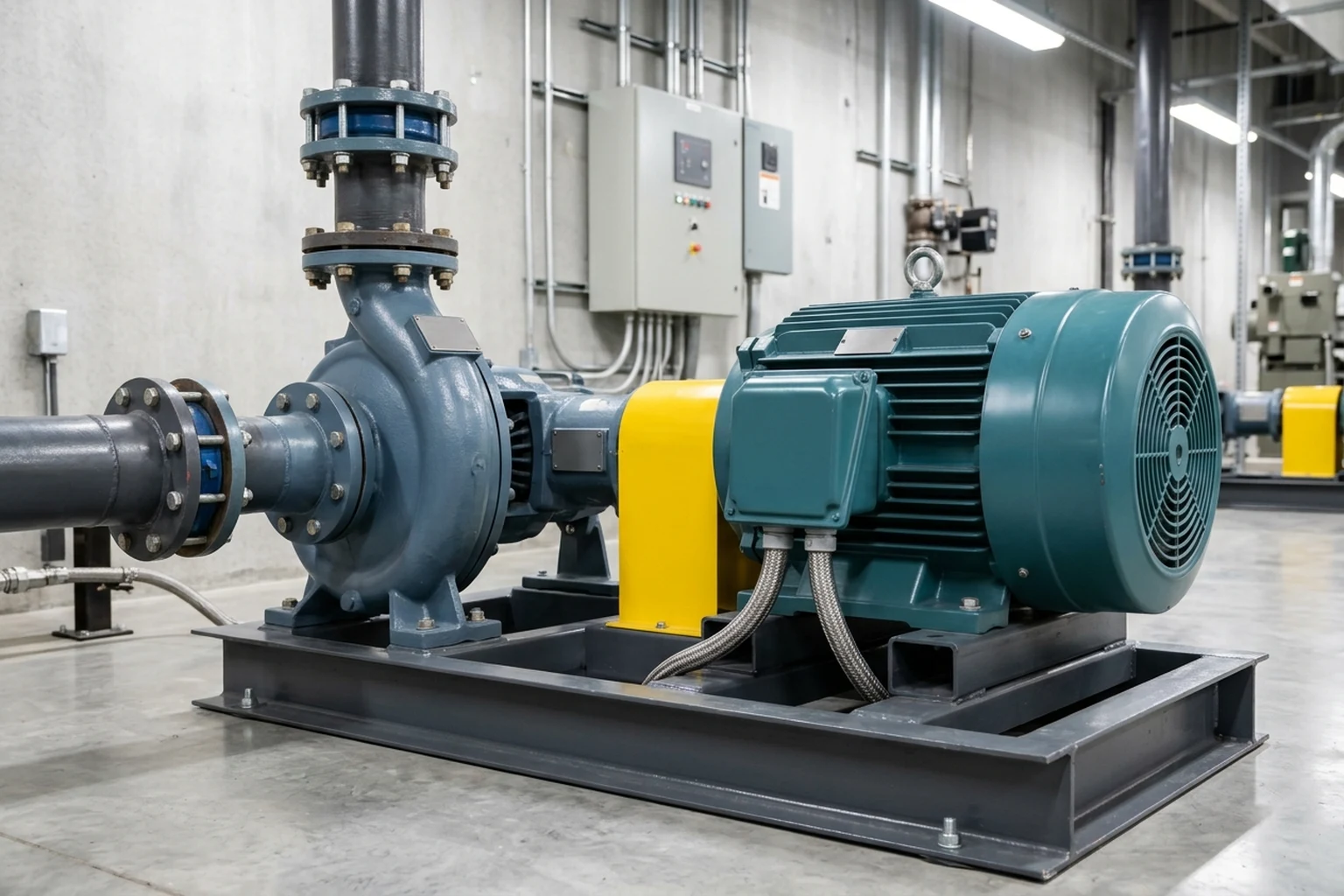
Centrifugal pump and three-phase induction motor skid with wall-mounted control cabinet, where variable-flow operation and static head govern the choice between a drive and a soft starter.
Duty Class, Thermal Derating, Inside-Delta Wiring, and Panel Coordination
Specifying either controller into custom VFD panels or motor control centers requires matching overload capability, ambient temperature and altitude derating, main and bypass contactor utilization categories, and short-circuit protection. You can also review our companion guide on how to choose a VFD for drive-specific sizing steps.
In softstarter duty classification, heavy-duty starts (big moment of inertia, long starting time, such as fans, crushers, mills and long conveyor belts) normally require overload (OL) class 30, while normal starts (small moment of inertia, short starting time, such as pumps, compressors, bow thrusters and short conveyor belts) normally use OL class 10.
Danfoss states that when sizing a VFD, the overload rating of the VFD will typically have the VFD running into its intermittent output current rating (which the VFD can run into for one minute out of every 10 minutes, depending on the manufacturer): constant torque applications may require 150 to 160 percent overload of motor current, whereas variable torque loads (centrifugal pumps, fans, blowers) may only require 110 to 120 percent overload current for one minute.
In the ABB Softstarter Handbook selection rules, if an application requires more than 10 starts/h, one size larger than the standard softstarter selection should be selected.
For ABB PST(B)30 to 1050 softstarters operating above 40 oC ambient temperature (such as 48 oC at 105 A or 46 oC at 300 A), rated current is derated by 0.8 % per oC above 40 oC.
For most manufacturers, softstarter catalogue values are valid up to 1000 m above sea level; above 1000 m, ABB softstarters calculate current derating with the formula % of Ie = 100 - (x - 1000) / 150, where x is the actual altitude.
In ABB's Guide to Variable Speed Drives, the squirrel cage motor has an IP54 degree of protection (dusty environment and sprinkling water from any direction), while the frequency converter usually has an IP21 degree of protection unless installed inside a cabinet with a higher degree of protection.
For three-phase controlled soft starters, panel designers must also choose between in-line (three-lead) and inside-delta (six-lead) motor wiring, select line and bypass contactors, and sequence the start command properly.
When a softstarter is connected inside-delta, 6 cables are required between the softstarter and the motor, and a 100 A motor requires a 58 A softstarter and a 58 A main contactor if placed in the delta circuit.
A softstarter controlling the voltage in only two of the three phases cannot be used inside the motor delta, and regardless of location the main contactor should be AC-3 rated for its current (the rated current of the motor outside delta or 58% inside delta).
In ABB's softstarter FAQ, all ABB softstarters are designed only for inductive loads (not capacitive or resistive loads), power factor correction capacitor banks must be placed on the line side (never between the softstarter and motor), the main contactor must always use AC-3, and the bypass contactor can use AC-1.
If a main contactor and softstarter receive a start signal at the same time and the main contactor closes too late, the softstarter indicates a phase loss fault; delaying the start signal to the softstarter by approximately 0.5 sec solves this phenomenon.
When protecting a softstarter with gG fuses (5s > 3.5 x In), aM fuses (5s > 9 x In), an MCCB, or a manual motor starter (MMS, available up to about 100 A), Type 1 short-circuit coordination can be achieved, whereas Type 2 coordination requires semiconductor fuses.
Engineering Selection Matrix: Soft Starter vs VFD by Application Profile
Use the engineering matrix below to match your machine load profile, starting duty, and speed-control requirements to the right controller category before submitting an inquiry:
| Evaluation criterion | Solid-state soft starter | Variable frequency drive |
|---|---|---|
| Primary control function | Smooth voltage ramp during start and stop only; motor runs at fixed utility frequency after acceleration. | Full speed, frequency, and torque regulation across starting, running, and stopping profiles. |
| Breakaway torque under load | Quadratic torque reduction when voltage is reduced; suited to low-to-moderate breakaway torque loads. | High starting torque available from zero speed while keeping starting current close to nominal motor current. |
| Full-speed running losses | Very low cabinet heat dissipation once internal or external bypass contacts close around the thyristors. | Continuous rectifier and inverter switching losses require active cabinet ventilation or cooling. |
| Variable-flow energy savings | No speed reduction during running; does not capture cubic affinity-law energy savings on throttled pumps or fans. | Adjusts pump or fan speed to match process demand, capturing substantial energy reductions on variable-torque loops. |
| Cabinet footprint and wiring | Compact footprint; three-phase controlled units support either in-line or six-lead inside-delta connection. | Larger enclosure depth and thermal clearance; requires three-lead output wiring between inverter and motor. |
Swipe or scroll horizontally to see all columns.
Prepare Your Soft Starter or VFD Package Enquiry
When requesting a commercial quotation for variable frequency drives, industrial soft starters, or assembled VFD control panels, share the application details below so our engineering team can align the controller architecture, overload class, and cabinet accessories with your site:
| Enquiry item | Technical details to include |
|---|---|
| Motor nameplate data | Supply voltage, frequency, shaft power, full-load current, service factor, pole count, and winding connection type. |
| Driven machine and torque profile | Identify the driven equipment and indicate whether the machine starts unloaded or under heavy breakaway load. |
| Operating speed and flow duty | State whether the motor runs at constant full speed after starting or requires continuous speed adjustment. |
| Starts per hour and ramp window | Specify expected starts per hour, desired acceleration ramp duration, and whether controlled soft stopping is needed. |
| Panel environment and coordination | Share cabinet ambient temperature, site elevation, enclosure protection target, bypass preference, and fuse coordination tier. |
Swipe or scroll horizontally to see all columns.
Discuss your project requirements with us via WhatsApp or through our contact page to compare multi-brand VFD and soft starter options matched to your motor list.
Frequently Asked Questions
Why does a motor fail to break away if a soft starter initial voltage is set too low?
Induction motor starting torque drops with the square of applied stator voltage. Setting the initial soft starter voltage pedestal to 20% leaves only 4% ($0.20^2 = 0.04$) of direct-on-line starting torque, which cannot overcome loaded shaft friction.
How much starting torque and current does a frequency converter use compared to a soft starter?
By adjusting both voltage and frequency from zero speed, a frequency converter delivers full rated motor torque right from standstill at roughly nominal rated current, tripping only if current reaches about 1.5 times rated current (versus 3–5 times nominal current on a soft starter).
When is a variable speed drive more cost-effective than a soft starter on a centrifugal pump?
Variable speed drives pay back fastest on centrifugal variable-torque pumps above 15–30 hp that run at least 2,000 hours per year in low-static-head loops, where a 20% speed reduction cuts shaft power by roughly 50% under the affinity laws.
Can a two-phase controlled soft starter be wired inside the motor delta?
No. Inside-delta (six-lead) motor wiring requires a three-phase controlled soft starter; two-phase controlled units must be wired in-line, and the main contactor must be AC-3 rated for full motor current in-line (or 58% of line current inside the delta).
Why does a soft starter trip on phase loss when energized simultaneously with its main contactor?
If the main contactor and soft starter start command fire together, mechanical contactor closure lag leaves the thyristors briefly unpowered, triggering a phase-loss fault. Delaying the soft starter start signal by roughly 0.5 seconds after contactor closure prevents the trip.
Sources
- International Electrotechnical Commission — Low-Voltage Switchgear and Controlgear Semiconductor Motor Controllers and Soft-Starters Publication
- ABB — Softstarter Technical Handbook and Application Manual
- WEG — Variable Frequency Drives Versus Soft Starters Technical White Paper
- United States Department of Energy Industrial Technologies Program — Adjustable Speed Pumping Systems Technical Tip Sheet
- Invertek Drives — Variable Frequency Drive Fundamentals Engineering Guide
- Danfoss — Variable Frequency Drive Sizing Application Guide
- ABB — Technical Guide to Variable Speed Drives
- Control Global — Soft Starters and Variable-Frequency Drives Engineering Comparison
- LS Electric America — Soft Starter and Variable Frequency Drive Application Guide
- Electronic Design — Compact Solid-State Soft Motor Starters Technical Report
- Power and Motion Tech — Industrial Soft Starters and Condition Monitoring Technical Report
- North Carolina State Extension — Industrial Fans and Ventilation Affinity Laws Publication