
Technical guide
NEMA 12 vs NEMA 4: Indoor Dust vs Washdown Enclosures
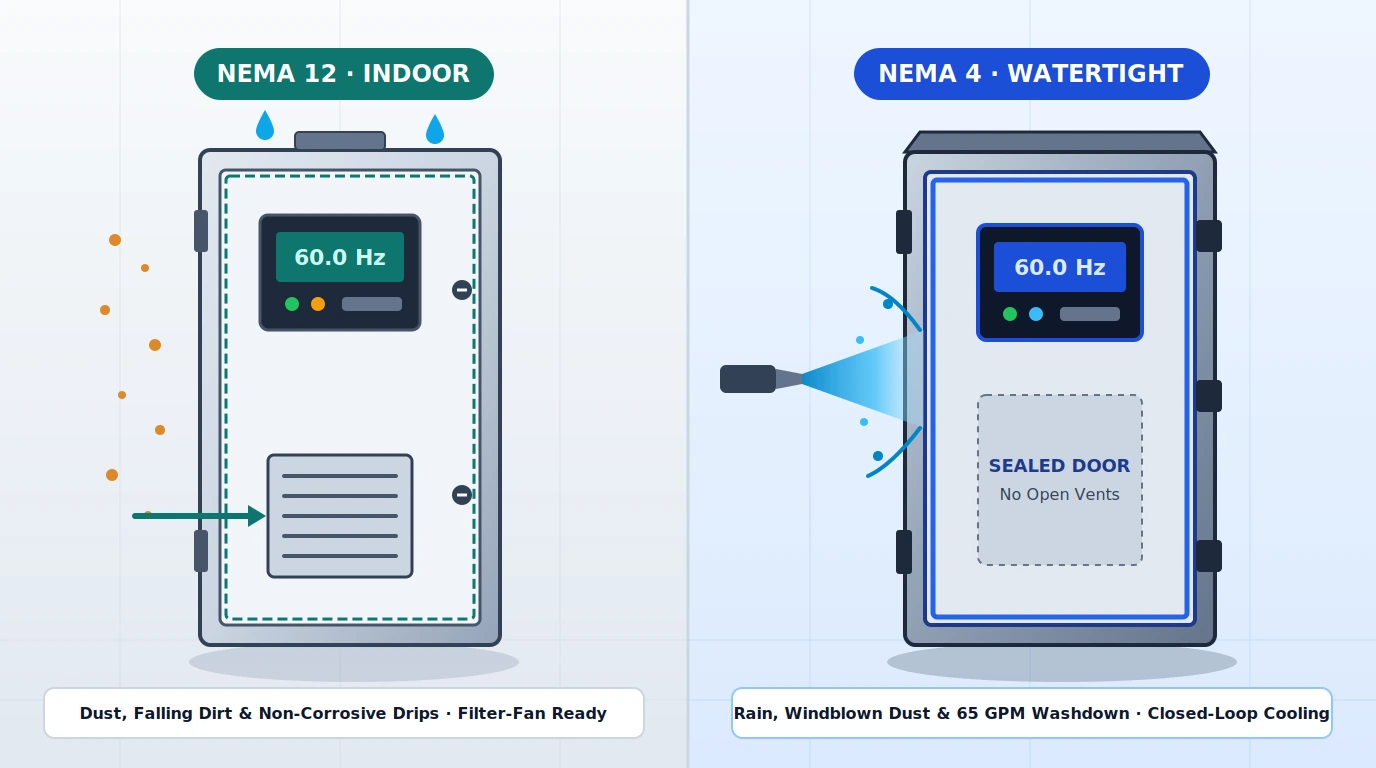
NEMA 12 is an indoor enclosure without knockouts for dust and non-corrosive drips, whereas NEMA 4 is a watertight indoor or outdoor cabinet rated for 65 GPM washdowns.
Jack Dean writes practical VFD selection, wiring, replacement and power-quality guides using current manufacturer documentation and explicit procurement checks.
Author profileUnder NEMA 250, a NEMA 12 enclosure is an indoor cabinet built without knockouts to block circulating dust, falling dirt, and dripping non-corrosive liquids, whereas a NEMA 4 enclosure is a watertight indoor or outdoor cabinet rated to exclude 65 GPM of hose-directed water from a 1-inch nozzle at 10 feet for 5 minutes.
For industrial VFD control panels, that environmental boundary directly governs how the cabinet rejects drive heat. Specifying a sealed, unventilated NEMA 4 cabinet on a dry indoor factory floor eliminates fresh-air filter-fan cooling and shifts heat rejection onto exterior surface area or closed-loop conditioning, which must be planned alongside VFD control panel heat and enclosure layout and variable frequency drive selection.
What Is a NEMA 4 Enclosure Rated to Withstand?
A NEMA 4 enclosure is a watertight indoor and outdoor electrical enclosure that must exclude at least 65 GPM of water from a 1-inch nozzle delivered from a distance not less than 10 feet for 5 minutes, while protecting enclosed equipment outdoors on ship docks and inside dairies, wastewater treatment plants, and breweries.
The National Electrical Manufacturers Association defines North American electrical enclosure standards in NEMA 250 to protect personnel from hazardous live parts and protect internal equipment from environmental hazards. Importantly, higher NEMA enclosure numbers do not automatically include lower-numbered tests: NEMA Types 3, 4, and 6 are intended for outdoor use, whereas Type 5 and Type 12 are intended for indoor use only.
By contrast, NEMA Type 12 and 12K enclosures are intended for indoor service, protecting VFD components against circulating dust, lint, fibers, flyings, falling dirt, and dripping non-corrosive liquids while meeting drip, dust, and rust resistance tests. Type 12 cabinets are constructed without knockouts to preserve their indoor dust seal, whereas Type 1 general-purpose indoor enclosures are not dust-tight and Type 2 adds drip shields for severe indoor condensation.
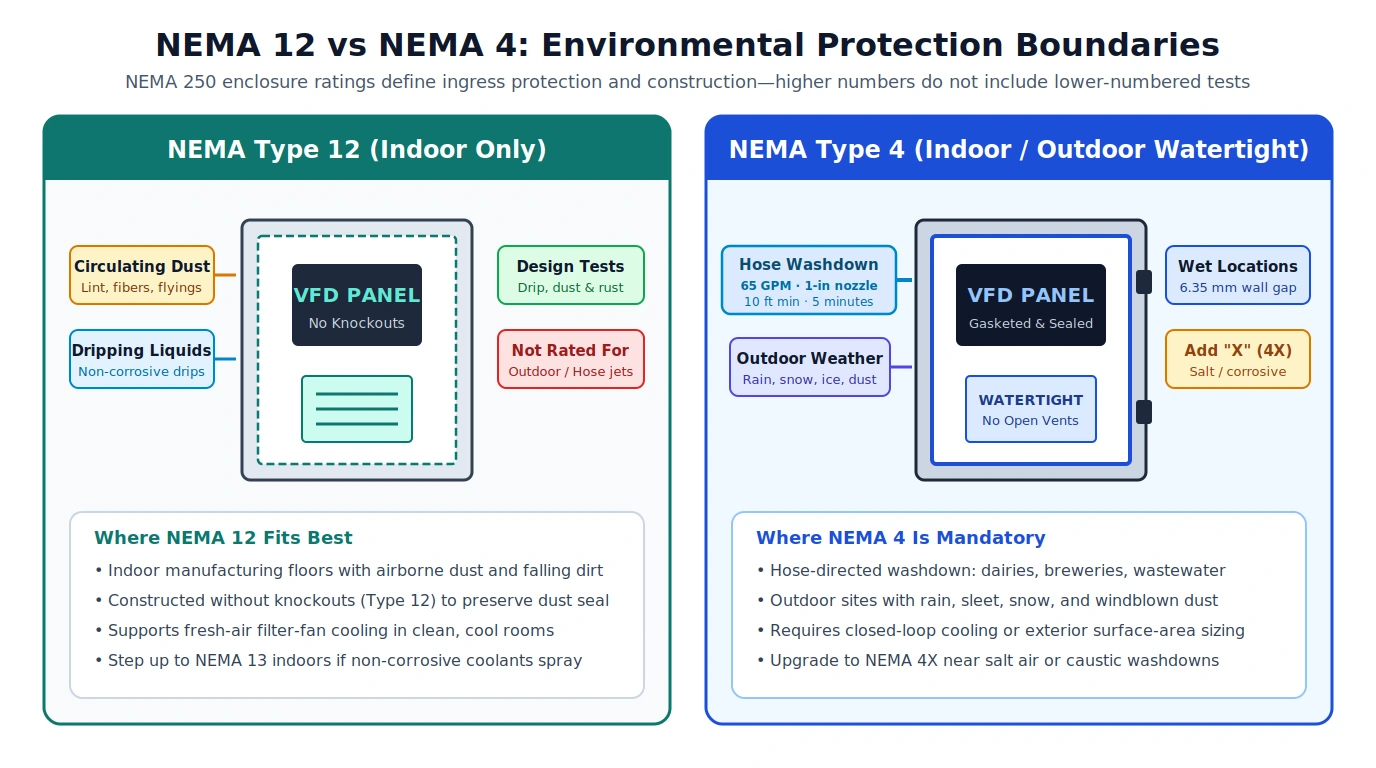
Environmental boundary comparison under NEMA 250: NEMA Type 12 protects indoor VFD panels against circulating dust and non-corrosive drips, whereas NEMA Type 4 adds watertight sealing for outdoor weather and 65 GPM hose-directed washdowns.
In damp or wet locations, federal electrical safety rules for panelboard enclosures require cabinets, cutout boxes, and panelboard enclosures to prevent moisture or water from entering and accumulating inside, with at least 6.35 mm (0.25 in.) of airspace between the enclosure and the supporting wall. Switches, circuit breakers, and switchboards in wet locations must also be housed in weatherproof enclosures.
| Specification criterion | NEMA Type 12 | NEMA Type 4 |
|---|---|---|
| Intended installation environment | Indoor industrial locations only | Indoor washdown rooms and outdoor exposed locations |
| Dust and particulate protection | Circulating dust, lint, fibers, flyings, and falling dirt | Falling dirt and windblown dust |
| Liquid ingress test boundary | Dripping non-corrosive liquids; meets drip, dust, and rust resistance tests | Watertight: excludes at least 65 GPM from a 1-inch nozzle at 10 feet minimum for 5 minutes |
| Cabinet construction and openings | Built without knockouts (Type 12); conductor and unused openings effectively closed | Continuous watertight gasketed seal; unused openings closed and 6.35 mm (0.25 in.) wall airspace in damp or wet locations |
| Typical VFD panel environments | Dry factory floors, assembly lines, indoor packaging halls | Ship docks, dairies, breweries, wastewater treatment plants, outdoor pump skids |
| Primary VFD cooling strategy | Fresh-air filter-fan ventilation in clean, cool indoor rooms | Sealed exterior surface-area dissipation or closed-loop enclosure air conditioner |
Swipe or scroll horizontally to see all columns.
What Is the IP Equivalent to NEMA 12 for Indoor Panels?
NEMA 12 has no exact one-to-one IP code equivalent because NEMA ratings address additional construction and environmental factors beyond ingress protection—including corrosion resistance, rust tests, external icing, and oil or coolant exclusion—whereas IEC 60529 classifies only solid intrusion, dust, accidental contact, and water ingress.
Published by the International Electrotechnical Commission under IEC 60529, the two-digit IP code separates solid-particle protection (first digit) from liquid ingress protection (second digit). Understanding the underlying test digits prevents mis-specifying an indoor dust cabinet on a washdown line:
- Solid dust digits (first digit 5 vs 6): First digit 5 (dust-protected) allows limited dust ingress that does not interfere with safe equipment operation, whereas first digit 6 (dust-tight) allows no dust ingress under vacuum test conditions.
- Splashing vs water-jet digits (second digit 4 vs 5 vs 6): Second digit 4 protects against splashing water from any direction (10 minutes via oscillating tube or 5 minutes minimum via spray nozzle). Second digit 5 tests water jets from a 6.3 mm (0.25 in.) nozzle at 12.5 liters per minute and 30 kPa (4.4 psi) from 3 meters (9.8 ft) for at least 3 minutes. Second digit 6 escalates to powerful water jets from a 12.5 mm (0.49 in.) nozzle at 100 liters per minute and 100 kPa (15 psi) from 3 meters (9.8 ft) for at least 3 minutes.
Because NEMA 12 covers indoor dust, falling dirt, and dripping non-corrosive liquids plus rust resistance rather than pressurized water jets, its ingress boundary sits closer to dust-protected and splashing-water service (first digit 5, second digit 4) than to pressurized jet washdown (second digits 5 or 6). Conversely, NEMA 4 is tested against hose-directed water at 65 GPM from a 1-inch nozzle and cannot be substituted with an indoor-only rating.
| Protection parameter | IEC 60529 IP code scope | NEMA 250 comparison boundary |
|---|---|---|
| Solid dust protection | First digit 5 (dust-protected) or first digit 6 (dust-tight under vacuum test conditions) | NEMA 12 protects indoors against circulating dust and falling dirt; NEMA 5 adds indoor dust-tight gaskets for steel mills and cement plants |
| Splashing water | Second digit 4: splashing from any direction (10 min oscillating tube or 5 min spray nozzle) | NEMA 12 covers dripping non-corrosive liquids indoors without outdoor weather or hose-jet testing |
| Hose-directed water jets | Second digit 5 (6.3 mm nozzle, 12.5 L/min, 30 kPa) and digit 6 (12.5 mm nozzle, 100 L/min, 100 kPa) at 3 m (9.8 ft) | NEMA 4 requires excluding at least 65 GPM from a 1-inch nozzle at 10 feet or more for 5 minutes |
| Corrosion, icing, and oil exclusion | Outside standard two-digit IP code scope | Explicitly covered across NEMA ratings, including rust resistance (Type 12), oil exclusion (Type 13), external ice (Types 3 and 4), and corrosion resistance (Type 4X) |
Swipe or scroll horizontally to see all columns.
Which Is Better Outdoors: NEMA 3R or NEMA 4?
NEMA 4 is better outdoors whenever a VFD cabinet faces windblown dust or pressurized hose washdowns, whereas NEMA 3R is suitable only for outdoor sites requiring protection against rain, sleet, snow, and external ice formation where windblown dust and hose-directed water are absent.
Under NEMA 250, NEMA Type 3 is a weather-resistant outdoor enclosure rated against falling dirt, windblown dust, rain, sleet, snow, and external ice formation, commonly installed outdoors on ship docks, construction sites, tunnels, and subways. NEMA Type 3R retains Type 3 weather protection against rain, sleet, snow, and ice damage, but explicitly omits protection against windblown dust. Where external operating mechanisms must remain operable while laden with ice, NEMA Type 3S extends Type 3 protection.
Neither NEMA 3 nor NEMA 3R carries the 65 GPM hose-directed watertight test required of NEMA 4. For outdoor VFD panels exposed to fine airborne particulates, agricultural or quarry dust, or routine washdowns, NEMA 4 prevents windblown dust and pressurized water from reaching sensitive power electronics, while NEMA 6 and 6P are reserved for submersible water or oil conditions in quarries, mines, and manholes.
When Do You Step Up From NEMA 12 or NEMA 4 to NEMA 4X?
Step up to NEMA 4X whenever a watertight indoor or outdoor VFD enclosure is also exposed to corrosive agents—such as salt air on ship docks, caustic cleaning chemicals in dairies and breweries, or corrosive atmospheres in wastewater treatment plants—because the X suffix designates additional corrosion resistance.
Just as the X suffix on NEMA 3X, 3RX, and 3SX adds corrosion protection commonly used near salt water, NEMA 4X combines the full 65 GPM watertight hose-down rating of NEMA 4 with corrosion-resistant enclosure construction. Electrical enclosures are manufactured from metals such as steel, stainless steel, or aluminum, or from rigid plastics depending on environmental and corrosion requirements.
Material choice also influences thermal behavior. Metal enclosures help conduct heat away from enclosed VFD electronics, whereas rigid non-metallic enclosures provide inherent corrosion resistance and electrical insulation. Selecting between painted steel (NEMA 12 or NEMA 4), stainless steel (NEMA 4X), and rigid plastic (NEMA 4X) therefore balances chemical exposure against heat dissipation and mechanical durability.
How Do Type 12 vs Type 4 Enclosure Seals Affect VFD Cooling?
Indoor NEMA 12 VFD cabinets in relatively clean, cool rooms can use fresh-air ventilation to exhaust component heat, whereas maintaining a watertight NEMA 4 rating requires a sealed, unventilated enclosure where passive heat rejection depends on exterior surface area rather than internal volume, with an enclosure air conditioner specified when internal temperature must stay at or below ambient.
Blindly upgrading an indoor VFD panel from ventilated NEMA 12 to a sealed NEMA 4 cabinet without recalculating thermal management is a common design failure. Cutting open filter-fan louvers into a NEMA 4 enclosure destroys its watertight rating, yet leaving a high-loss drive sealed inside an undersized cabinet traps heat inside.
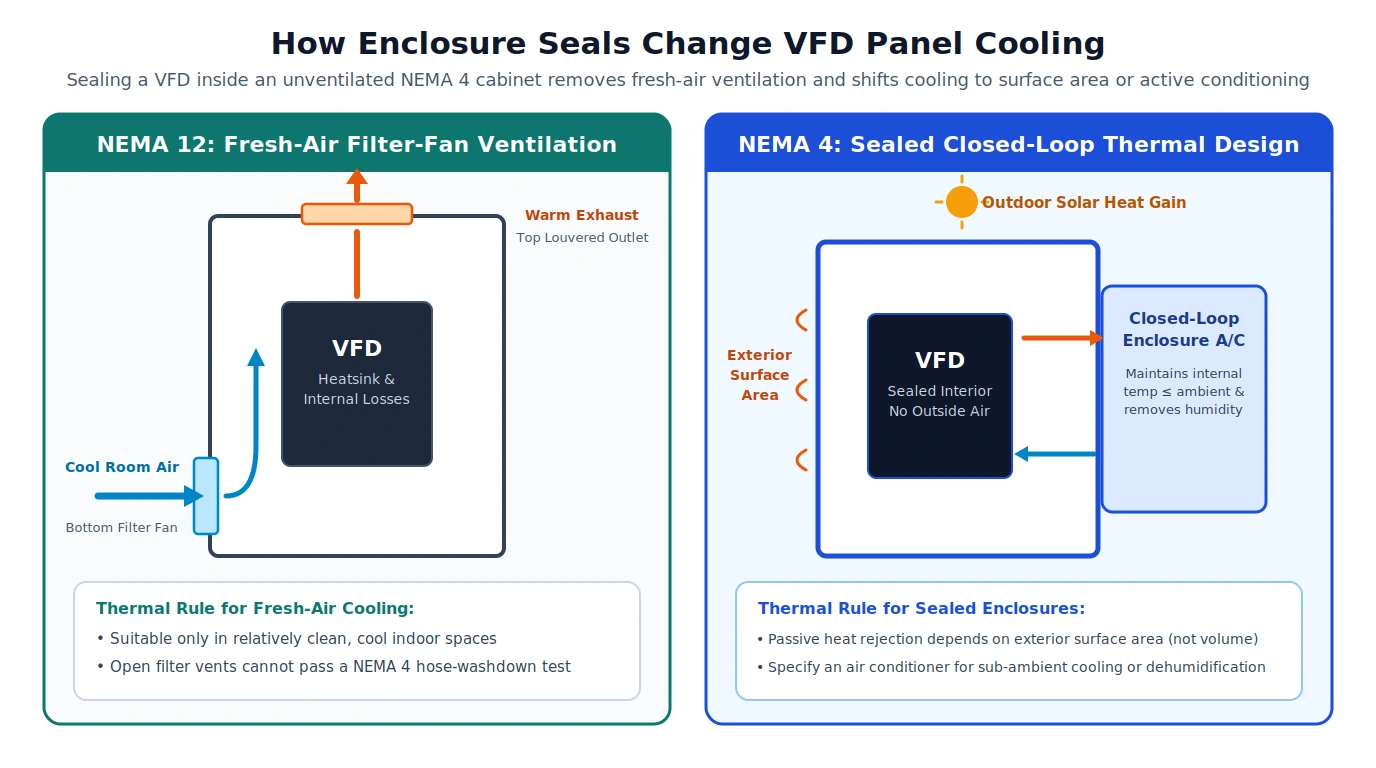
Thermal impact of enclosure sealing: fresh-air filter-fan cooling works in clean, cool indoor NEMA 12 rooms (left), whereas sealed NEMA 4 cabinets (right) reject heat through exterior surface area or a closed-loop enclosure air conditioner while accounting for outdoor solar heat gain.
Four thermal engineering rules govern sealed NEMA 4 and NEMA 4X VFD enclosures:
- Size sealed cabinets by exterior surface area, not volume: For gasketed, unventilated enclosures, larger exterior surface area lowers the temperature rise from internally generated heat; internal enclosure volume cannot be used in place of surface area when estimating passive dissipation.
- Account for outdoor solar heat gain: Any NEMA 4 or NEMA 4X cabinet mounted outdoors in sunlight absorbs additional radiant thermal load, so solar heat gain must be included in outdoor enclosure thermal management.
- Specify an enclosure air conditioner for sub-ambient targets: An enclosure air conditioner should be specified whenever the temperature inside the sealed VFD cabinet must be maintained at or below the surrounding ambient temperature.
- Control internal moisture in humid or washdown sites: An enclosure air conditioner should also be specified whenever humidity must be removed from the cabinet interior, coordinating thermal sizing with our VFD control panel heat and enclosure layout guide.
How Do You Decide Between NEMA 12 or NEMA 4 for a Factory Floor?
Decide between NEMA 12 and NEMA 4 by checking four site boundaries: dry indoor dust and non-corrosive drips select NEMA 12, spraying indoor coolants require NEMA 13, pressurized washdowns or outdoor weather require NEMA 4, and corrosive washdowns or salt air require NEMA 4X, paired with sealed thermal sizing.
Do not assume a NEMA enclosure rating automatically satisfies third-party listing requirements: a NEMA enclosure rating does not mean the cabinet also meets the same UL enclosure rating, so verify both environmental type and required agency markings on the bill of materials. During panel assembly and field wiring, protect conductors entering cabinets from abrasion, effectively close all conductor entry openings and unused openings, and mount panelboards in dead-front cabinets designed for the purpose.
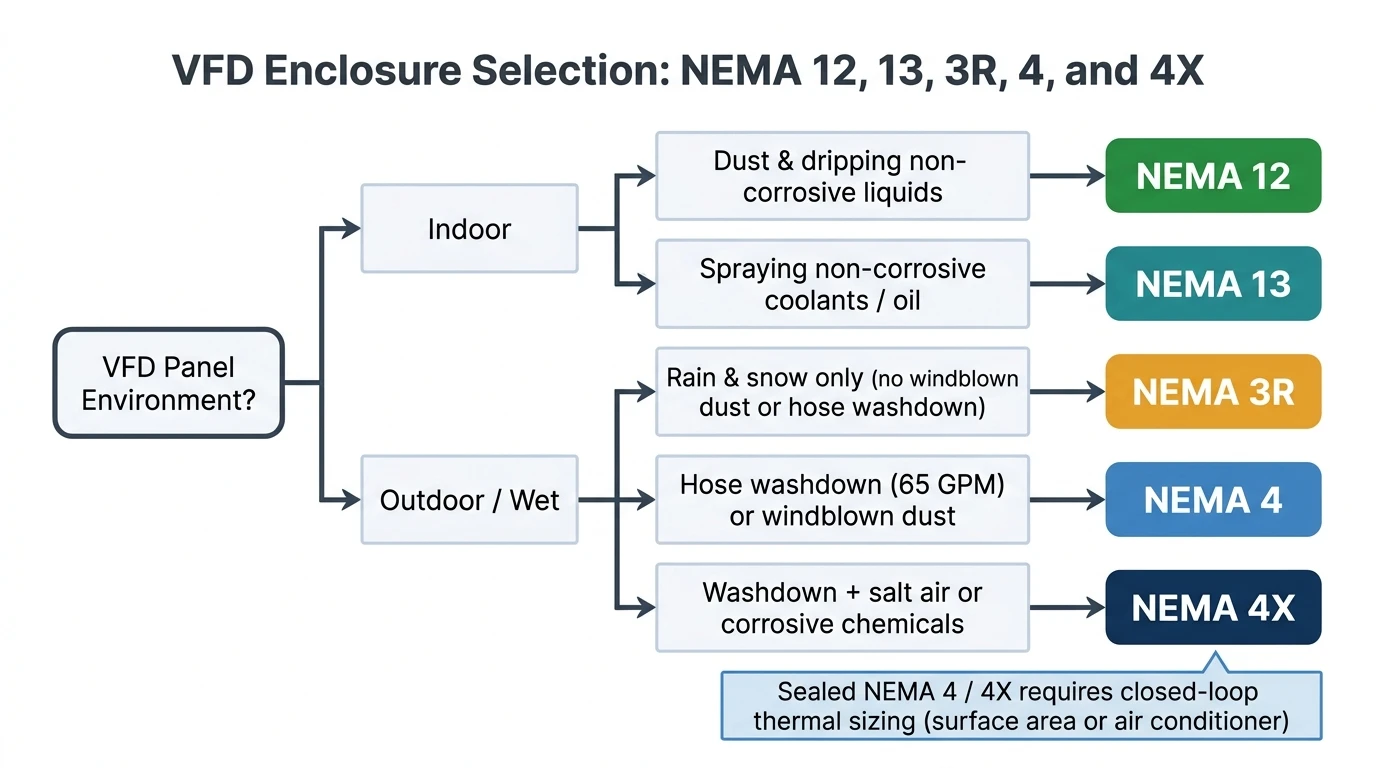
Factory and outdoor VFD enclosure decision path across NEMA 12, NEMA 13, NEMA 3R, NEMA 4, and NEMA 4X, highlighting the sealed closed-loop thermal sizing checkpoint for NEMA 4 and 4X panels.
Use this factory-floor selection checklist before locking your enclosure specification:
| Site environment and hazard | Recommended NEMA type | Key construction and cooling verification |
|---|---|---|
| Indoor dry plant with circulating dust, lint, falling dirt, and light non-corrosive drips | NEMA 12 | Built without knockouts; verify fresh-air filter-fan cooling is suitable for room cleanliness and ambient temperature |
| Indoor machining area with spraying water and non-corrosive coolants or oil | NEMA 13 | Meets indoor oil exclusion and rust resistance design tests; seal all unused openings |
| Outdoor sheltered site with rain, sleet, snow, and ice, but no windblown dust or hose washdown | NEMA 3R | Confirm absence of windblown dust; include outdoor solar heat gain in thermal review |
| Indoor washdown room or outdoor exposed site with windblown dust and pressurized hoses | NEMA 4 | Watertight to 65 GPM (1-inch nozzle, 10 ft, 5 min); maintain 6.35 mm (0.25 in.) wall airspace and size surface area or closed-loop air conditioner |
| Washdown or outdoor site with salt air, caustic cleaners, or wastewater corrosion | NEMA 4X | Watertight plus corrosion-resistant stainless steel or rigid plastic; specify enclosure air conditioner for sub-ambient cooling or dehumidification |
Swipe or scroll horizontally to see all columns.
Share your motor schedule, ambient temperature, washdown exposure, and cooling requirements on WhatsApp or submit a custom VFD control panel enquiry to match your variable frequency drives with the right NEMA enclosure and thermal management package.
Frequently Asked Questions
Can a NEMA 12 enclosure be used outdoors under a roof or awning?
No—NEMA Type 12 is defined strictly for indoor use against dust, falling dirt, and dripping non-corrosive liquids, whereas outdoor service requires an outdoor-rated enclosure such as NEMA 3R, NEMA 3, NEMA 4, or NEMA 4X depending on windblown dust, washdown, and corrosion exposure.
Does a higher NEMA number always provide better protection than a lower number?
No—under NEMA 250, higher enclosure type numbers do not automatically include lower-numbered tests; for example, Types 3, 4, and 6 are intended for outdoor use while Type 5 and Type 12 are indoor-only.
What is the difference between NEMA 12 and NEMA 13 for indoor VFD panels?
Both are indoor industrial enclosures, but NEMA Type 12 protects against dust, falling dirt, and dripping non-corrosive liquids, whereas NEMA Type 13 adds protection against spraying water and non-corrosive coolants and meets oil exclusion and rust resistance design tests.
Does a NEMA 4 enclosure automatically meet a UL Type 4 rating?
No—a NEMA enclosure rating does not automatically mean the enclosure meets the same UL enclosure rating, so engineers must verify independent UL listing separately when project specifications require it.
When does a sealed NEMA 4 VFD panel require an enclosure air conditioner?
Specify an enclosure air conditioner whenever a gasketed, unventilated NEMA 4 VFD cabinet must maintain an internal temperature at or below the ambient temperature, or whenever humidity must be removed from inside the enclosure.