
Technical guide
VFD Control Panel Heat and Enclosure Layout
Plan your VFD control panel: review drive heat losses, enclosure protection, cooling layout and condensation before preparing a panel enquiry.
Jack Dean writes practical VFD selection, wiring, replacement and power-quality guides using current manufacturer documentation and explicit procurement checks.
Author profileUpdated October 28, 2026.
Start your VFD control panel review with the heat-loss data, enclosure environment and mounting layout. Use the checklist below to prepare a VFD panel enquiry.
The heat generated within the enclosure must be known for a temperature-rise calculation.
Overheating can shorten electrical-component life or lead to catastrophic failure.
What to collect before choosing the enclosure
Use this worksheet to organize the panel review. Record the exact equipment and intended installation in each row.
| Review item | Information to collect |
|---|---|
| Drive | Catalog number, mounting arrangement and published heat-loss data |
| Cabinet | Dimensions, available exterior surfaces and proposed component layout |
| Site | Ambient temperature, indoor or outdoor location, dust and moisture exposure |
| Cooling | Intended cooling method, intake and exhaust positions, filter access |
| Verification | Load conditions and commissioning temperature record |
Swipe or scroll horizontally to see all columns.
VFD heat dissipation: use the model-specific watts
Component suppliers can provide the heat-generation information.
Compare these nominal-current loss entries from the same drive family:
ATV320U02M2B dissipates 19 W at nominal current.
ATV320U02M2C dissipates 17 W at nominal current.
ATV320U04N4B dissipates 23 W at nominal current.
ATV320U04N4C dissipates 23 W at nominal current.
ATV320U04N4B has a listed minimum required air flow of 9.4 m3/h.
ATV320U04N4C has a listed minimum required air flow of 18 m3/h.
Record the loss figure and required drive airflow alongside the exact catalog number.
Cabinet and flush-mounting review
If you install ATV630 in the cabinet and want to design cabinet ventilation, calculate total losses as forced losses plus natural losses.
With the flush-mounting kit, forced air is blown outside the enclosure.
In the described flush-mounting arrangement, enclosure cooling must be designed only for natural losses.
For the flush-mounting arrangement above, record the drive contribution separately from the other cabinet components.
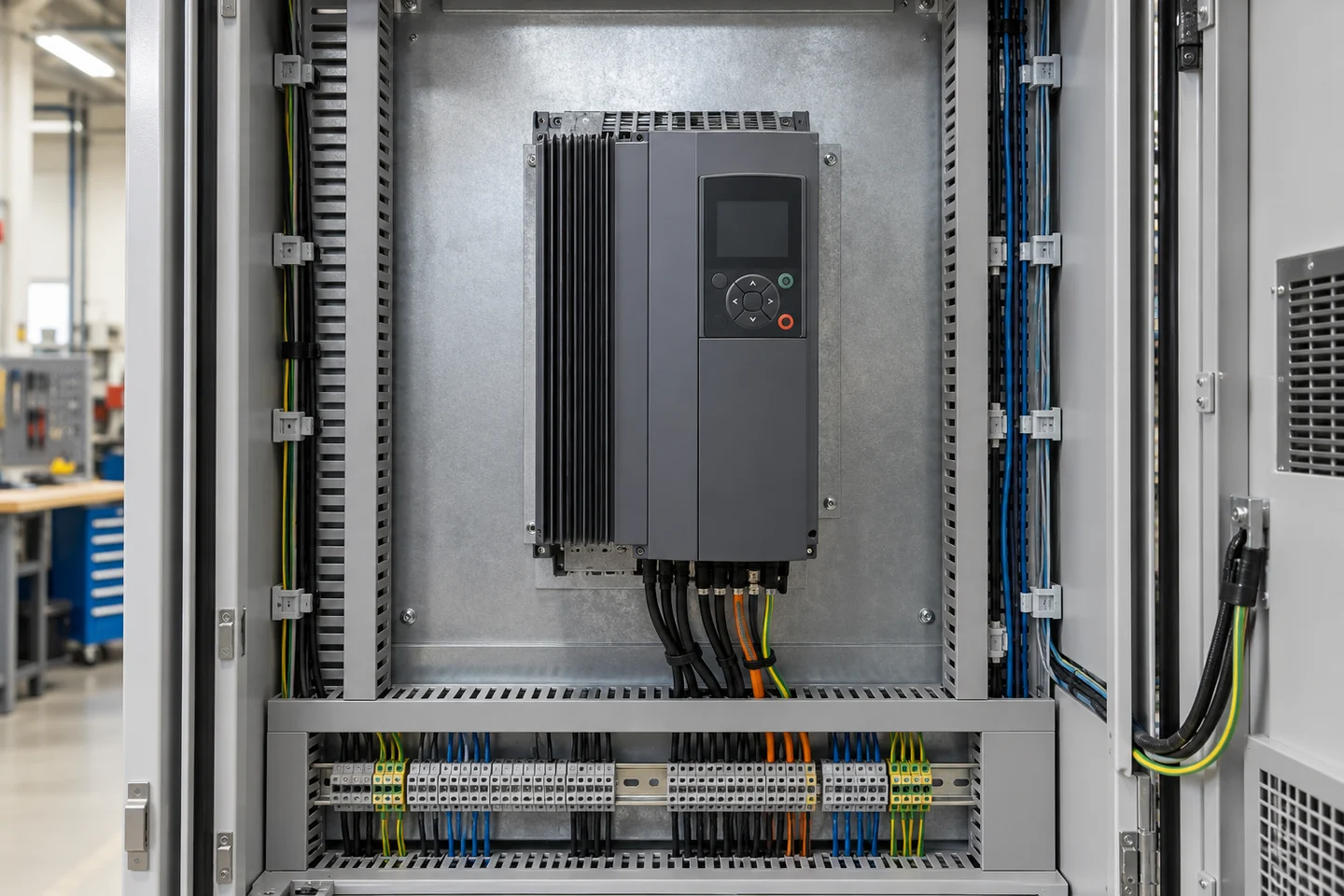
Review the proposed drive position and surrounding space.
Enclosure size: review the usable surface area
For gasketed, unventilated enclosures, larger enclosure surface area lowers the temperature rise from internally generated heat.
Enclosure volume cannot be used in place of surface area.
If a surface is unavailable for heat transfer, its area should be subtracted.
For the sealed-enclosure temperature-rise assessment, actual temperature rise will vary due to enclosure layout, internal fan use and nearby air movement.
Solar heat gain must be considered for outdoor enclosure thermal management.
Mark wall-facing surfaces on the cabinet drawing, and include the outdoor location in the enquiry where applicable.
NEMA enclosure selection: indoor dust or weather exposure?
Compare the protection descriptions below for a completely and properly installed enclosure in a non-hazardous location.
Type 3R enclosures are constructed for indoor or outdoor use.
Type 3R provides a degree of protection with respect to harmful effects on the equipment due to the ingress of water (rain, sleet, snow).
Type 3R includes protection against falling dirt.
Type 12 enclosures are constructed without knockouts for indoor use.
Type 12 includes protection against circulating dust, lint, fibers and flyings.
Type 12 provides a degree of protection with respect to harmful effects on the equipment due to the ingress of water (dripping and light splashing).
Record the intended enclosure type and environmental exposure together. Keep the cooling review alongside that selection.
VFD enclosure cooling: choose the method and airflow path
Fresh-air enclosure cooling ventilates fresh air through the cabinet to exhaust heat from components.
Fresh-air cooling may be used in a relatively clean and cool environment.
An air conditioner should be specified when the temperature inside the enclosure must be maintained at or below the ambient temperature.
An air conditioner should be specified when humidity must be removed.
Fan-in arrangement
In the standard fan-in arrangement with a single exhaust, the filter fan is installed at the cabinet bottom and the exhaust at the top.
The standard single-exhaust arrangement preferably uses opposite sides of the cabinet.
In this fan-in arrangement, positive cabinet pressure assists in keeping particulates from entering through small unseen openings.
Fan-out arrangement
In the fan-out arrangement with a single exhaust, negative cabinet pressure allows particulates to enter through unseen openings.
In this fan-out arrangement, the top-mounted fan motor is exposed to a higher temperature.
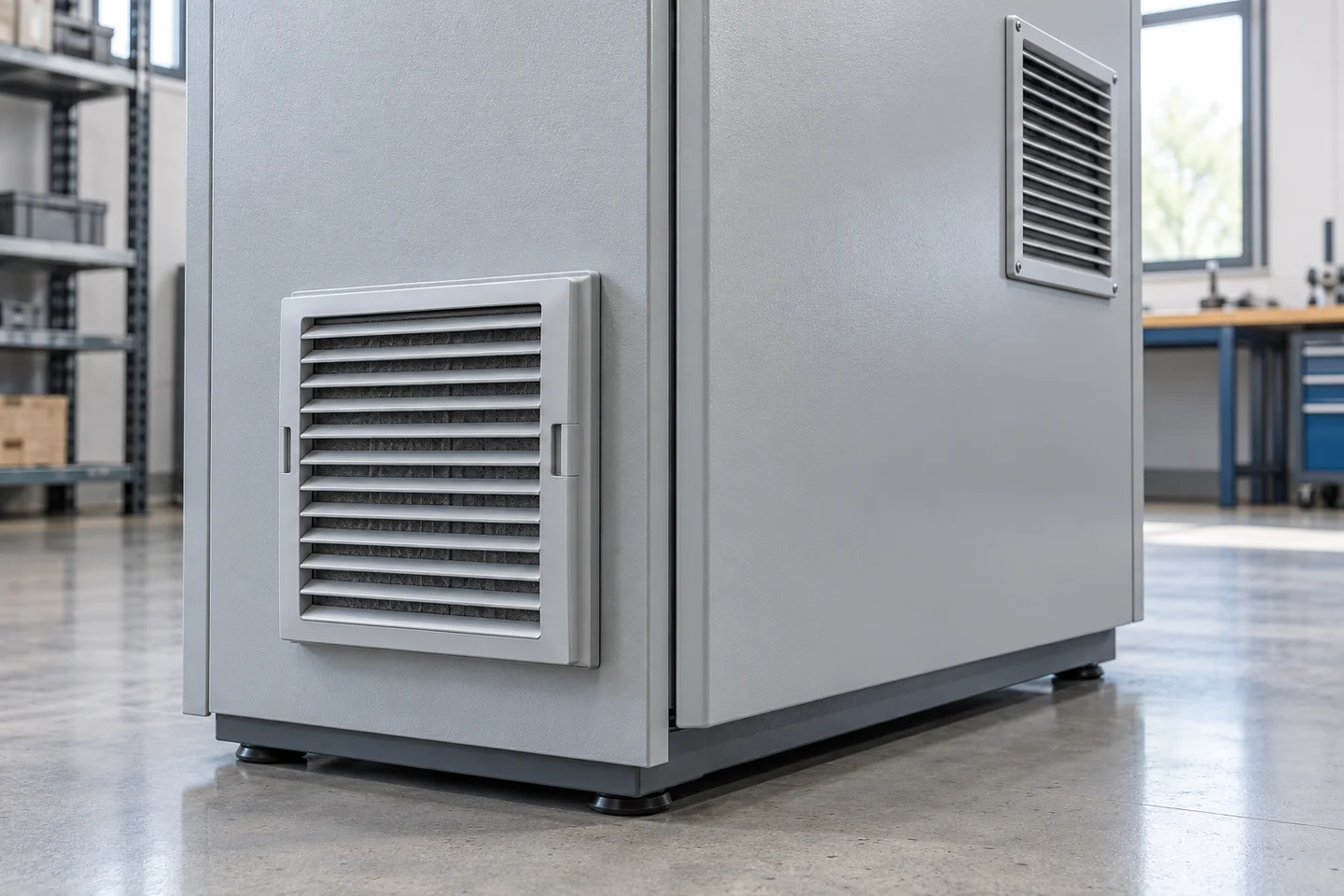
Include the intake, exhaust and filter-access positions in the layout review.
Drive mounting and commissioning checks
For the drive family used in the nominal-current examples above, apply these mounting and hot-surface checks:
Do not mount the device close to heat sources.
Adhere to the minimum installation distances required for cooling.
Do not allow flammable or heat-sensitive parts near hot surfaces.
Verify heat dissipation with a test run under maximum load conditions.
Keep the mounting drawing beside the commissioning record. Record the tested load and observed temperatures.
Account for condensation as well as heat
Condensation occurs when moist air contacts a surface at or below its dew point.
Heaters can prevent condensation when processing lines are not operating.
Thermostats can control heating equipment, cooling equipment, or both.
Maintenance questions to resolve before handover
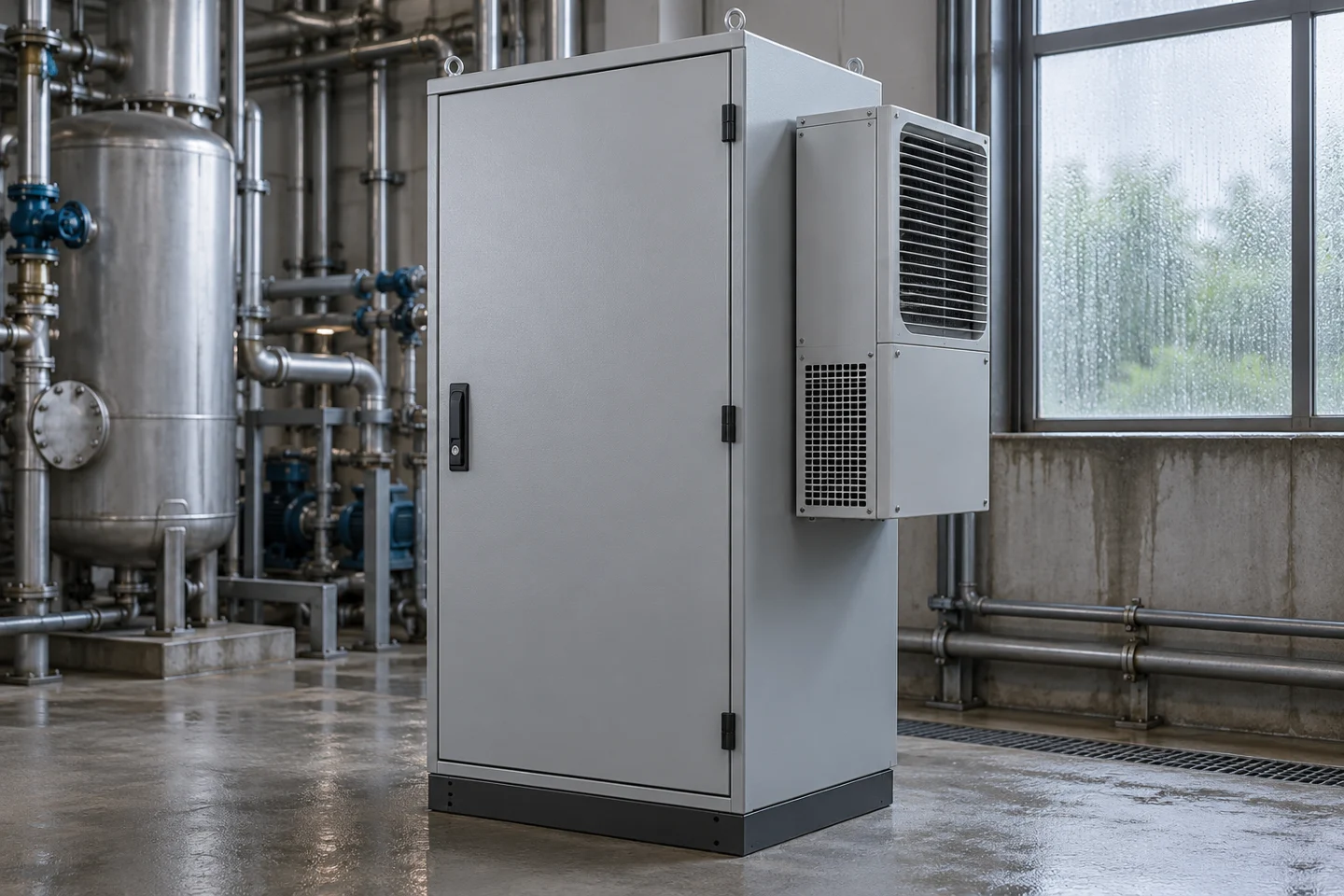
A clogged airflow path can cause overheating.
Inspect and clean cabinet air inlets, outlets and filters if required.
For the drive family in the loss examples:
Fan operation depends on the drive thermal state.
Add filter inspection and the drive maintenance instructions to the handover checklist.
Prepare your panel enquiry
Bring the drive catalog number, published heat losses, enclosure dimensions, ambient temperature and proposed layout to your VFD panels enquiry. Include the intended enclosure type and cooling method. For the broader installation scope, use the VFD installation cost quote checklist.
Contact us with your panel requirements, or use the page’s WhatsApp enquiry button.
Sources
- Schneider Electric — Altivar installation manual
- Schneider Electric — Cabinet convection guidance
- nVent HOFFMAN — Heat Dissipation in Electrical Enclosures
- nVent HOFFMAN — Industrial/Commercial Thermal Management
- nVent HOFFMAN — Mitigating Condensation
- NEMA — Enclosure Types
- Pfannenberg — Filterfan Configurations
- Pfannenberg — Accessories