
技术指南
Single-Phase to Three-Phase VFD: A Compatibility Check Before You Buy
Confirm single-phase input permission, motor voltage and current, and supply review before you order.
Jack Dean 基于制造商当前资料和明确的采购核对项,撰写 VFD 选型、接线、替换及电能质量实用指南。
查看作者资料Ordering a drive that is not approved for single-phase input can overstress its rectifier and DC-bus capacitors and still leave your three-phase motor without a dependable supply. A VFD can run a three-phase motor from single-phase power only when the exact drive variant is built for single-phase input, or its manufacturer explicitly approves that input with stated derating. This guide turns that rule into a four-step check and a blank approval matrix you complete before you buy.
Short answer: yes, a VFD can turn a single-phase supply into a three-phase motor supply—but only on a drive whose manual or manufacturer explicitly permits single-phase input. Some manufacturers make drives for this; others allow it only on an oversized, derated unit; and some drives are not approved for it at all. Phase conversion also leaves three questions open: whether the drive's output voltage suits the motor's rated voltage and connection, whether the drive's derated continuous current and its overload rating still cover the motor, and whether your supply and input protection meet the manual. Record each answer against a document page before ordering.
This is a buyer's record for the VFD Learning Center, not a sizing course. If the drive itself is new to you, start with how a VFD works.
| Input or record | Where the value comes from | Why it matters |
|---|---|---|
| Single-phase input permission | Exact drive manual (catalog variant, revision, page) or written manufacturer reply | Without it the arrangement is unapproved, whatever the drive size |
| Single-phase derating and accessories | The same manual or reply | Sets the usable output current and any required line-side device |
| Motor rated voltage and connection | Motor nameplate or motor documentation | Must suit the drive's output voltage; phase conversion alone does not settle it |
| Motor full-load current at the operating voltage | Motor nameplate | The figure the drive's derated continuous current must cover |
| Required overload, its duration, and duty | Load data or machine builder | Checked against the drive's short-time overload rating, not its continuous one |
| Supply voltage, frequency, capacity and grounding | Site electrical records | Must suit the drive's permitted input and its single-phase input current |
| Ambient temperature and altitude | Installation site | Can further reduce usable output current |
| Sign-off owner | Drive manufacturer or a qualified person | An article or a supplier chat is not an approval |
横向滑动或滚动以查看所有列。
How does a VFD convert single-phase power to three-phase output?
A VFD first rectifies the incoming AC into DC, smooths it in a DC link, and then an inverter switches that DC into a three-phase output whose frequency and voltage the drive controls. The motor only sees the inverter output, so the drive can be fed from a single-phase supply—provided its input stage is rated or approved for that.
ABB's Technical Guide No. 4 describes these three parts—rectifier, DC bus circuit and inverter—as the basis of a frequency converter. The inverter connects each motor phase to the positive or negative side of the DC bus in a controlled sequence, which is what produces the three-phase output. The input stage, however, does not experience single-phase and three-phase supply equally.
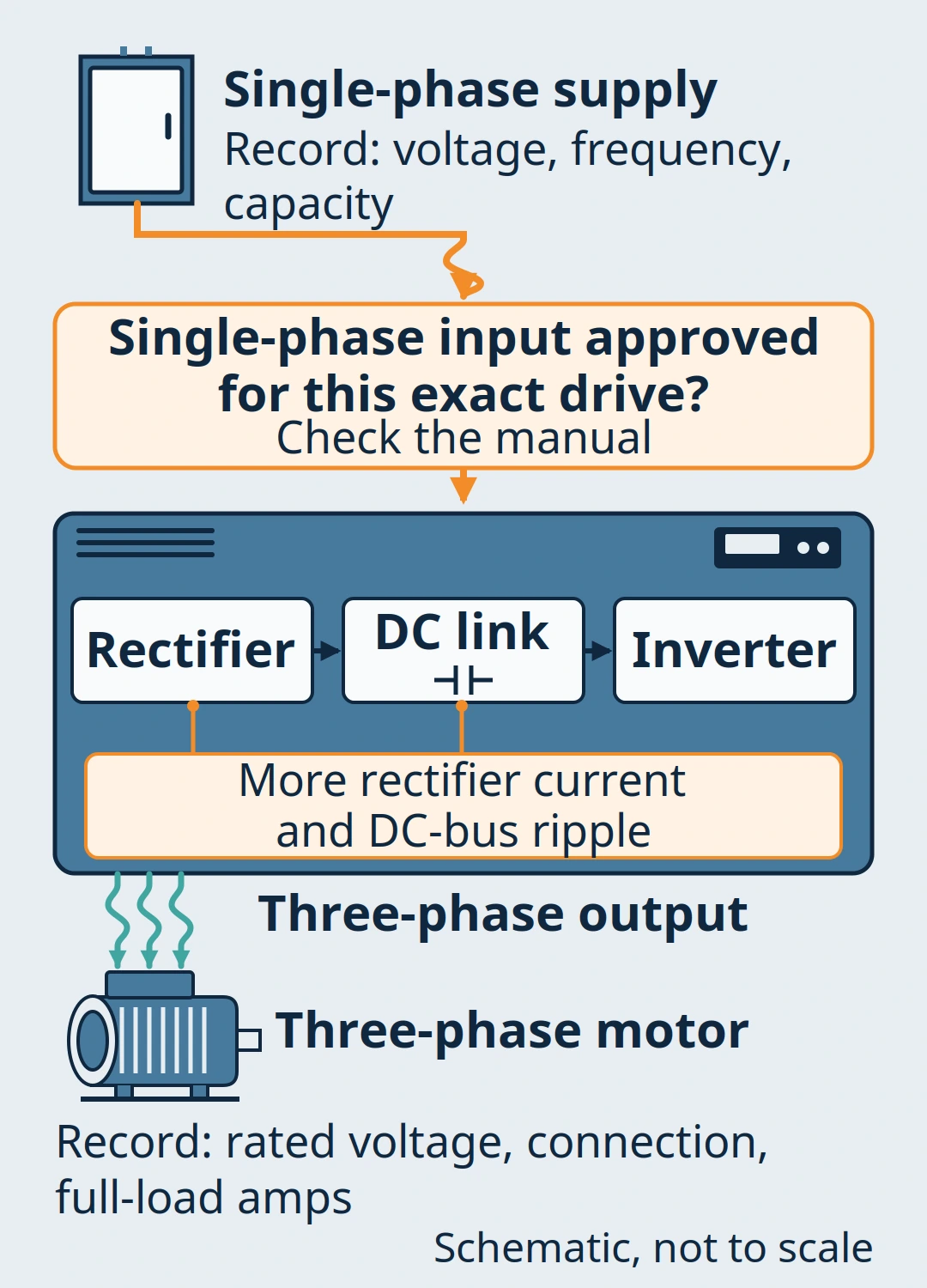
Schneider Electric's drive FAQ explains the difference. With single-phase input, the input rectifiers carry more current than in normal three-phase operation, and the DC-bus capacitors see significantly higher voltage ripple, which adds thermal and electrical stress. That is why a three-phase-input drive approved for single-phase use is normally oversized and may need a line reactor—and Schneider stresses that this applies only to drives specifically approved for single-phase operation. What a line reactor does on the input side is explained in VFD harmonics and line reactors.
Takeaway: The conversion happens inside the drive; whether your drive may do it from a single-phase input is a separate, documented permission.
Why doesn't phase conversion settle voltage or current?
Getting three phases out of a drive answers only the phase question. The motor still needs its rated voltage in the connection it is wired for. After derating, the drive's continuous output current must cover what the motor draws in steady running, and its short-time overload rating must cover starting and peaks for as long as they last. Treat voltage and each current figure as separate entries, each with its own source.
Voltage. Keep four voltage entries apart: the supply voltage you actually have; the input voltage the drive permits on single phase; the output voltage the drive can deliver from that input; and the motor's rated voltage for its connection. Danfoss notes that a drive operates only on the voltage it was designed for, while a motor can be rated for more than one voltage. Whether a particular drive can give your motor its rated voltage from your single-phase supply is a question for that drive's manual. Do not assume the answer in either direction.
Current. Danfoss's sizing guidance is to size a VFD from motor current and voltage, not horsepower; a dual-voltage motor draws a different full-load current at each voltage, so the operating voltage decides which current you record. Danfoss also notes submersible motors typically draw more current per horsepower than NEMA B motors—relevant if you are running a pump from a VFD. If the motor itself is still being chosen, compare candidates on the industrial motors page with this current question in mind.
Common mistake: Ordering "a 3 hp single-phase VFD" for a 3 hp motor. Matching labels say nothing about single-phase permission or derated current.
Takeaway: Record voltage and current from the nameplate and the manual, each with its source.
Step 1 — Record the motor, load and supply
Before looking at any drive, capture the motor nameplate, the load's duty and the supply you actually have. These records decide every later row; an estimate here makes the rest of the check unreliable. Leave unknown cells blank and mark them unresolved rather than guessing.
| Record | What to write down | Usual source |
|---|---|---|
| Motor identity | Make, full type or catalog identifier, serial number if visible | Motor nameplate |
| Rated voltage(s) | Every voltage shown, and which connection the motor is currently wired for | Nameplate, motor documentation |
| Full-load current | The value for your operating voltage; service-factor current if the load runs into it | Nameplate |
| Frequency and speed | Rated frequency, base speed and the speed range the process needs | Nameplate, process requirement |
| Load and duty | What the motor drives, how hard it starts, any overload the application needs | Machine builder, process owner |
| Supply | Voltage, phase, frequency, available circuit capacity and grounding arrangement | Site electrical records |
| Environment | Ambient temperature range, altitude and where the drive will be mounted | Site survey |
横向滑动或滚动以查看所有列。
Accuracy matters beyond the purchase. The drive user manual we reviewed for this guide, for example, asks for the motor's nameplate volts, frequency and full-load amps as setup values, so a transcription error carries straight into commissioning. If you are unsure how hard the load starts, the load-duty section of how to choose a VFD explains the difference between variable-torque and constant-torque duty.
Takeaway: A complete, sourced motor and supply record is the input for every later check—blank is better than guessed.
Step 2 — Find written permission for single-phase input
Accept only two kinds of evidence: a published single-phase input rating for the exact catalog variant, or the manufacturer's explicit instructions for running that variant on single-phase input, including any derating and accessories. If the manual is silent, the answer is unresolved, not yes.
Schneider's FAQ states plainly that not all drives are designed or approved for single-phase input and directs users to the specific drive's installation manual or technical support for confirmation. Danfoss separates units designed for single-phase input from drives oversized and derated for it, cautions that derating "may not be fully UL-listed", and recommends drives tested and certified for single-phase input with three-phase output. Record which approach your candidate uses and, if your inspector or end user requires a listing, the listing basis for that arrangement.
Permission can be easy to miss. In one 2024 drive user manual we reviewed, a footnote to the power-terminal table provides an example: it permits single-phase input subject to a product-specific derate of the drive's rated current, and the technical specifications in the appendix state the same reduction under input phases. Those figures belong to that product family and must not be carried to other drives. The lesson is practical: check both the wiring tables and the specifications, and record the document number, revision and page, not just "the manual says it's OK."
For each candidate, write down:
- Manufacturer and full catalog number, including suffixes
- Manual title, publication number and revision or date
- Page, table or footnote that permits single-phase input
- Derating, accessories or conditions stated there
- Reference and date of any manufacturer support reply
If you need to find the right manufacturer support channel, our comparison of VFD manufacturers shows how the main brands organise their drive ranges. If the drive replaces an existing unit, the VFD replacement checklist covers the other identification records you will need.
Common mistake: Running a standard three-phase-input drive with one input phase missing, or buying "one size up" without written permission. Oversizing is a condition of some approvals, not a substitute for one.
Takeaway: No page reference, no permission—treat a silent manual as an open question for the manufacturer.
Step 3 — Check usable current and supply conditions after derating
Make two current comparisons and one supply review. First, the drive's continuous output current after single-phase, temperature and altitude derating must cover the motor's continuous current: its full-load current at the operating voltage, or its service-factor current if the load runs into the service factor. Second, the drive's short-time overload current, and the time it may be held, must cover starting and process peaks. Separately, the drive's single-phase input requirements must suit your supply and protection.
Output side. Take the drive's continuous output current for the duty class you need, apply the single-phase derating from Step 2, then any derating the manual requires for ambient temperature and altitude; Danfoss notes that higher altitude and higher ambient temperature both reduce a drive's ability to shed heat, by amounts that vary by manufacturer and size. Then read the overload rating separately. The 2024 manual mentioned in Step 2, for example, lists continuous output current by catalog number and states intermittent overload as separate levels, each with its own time limit. Danfoss advises covering a load that runs continuously into its service factor with the drive's continuous rating, not its intermittent one. If either comparison falls short, the candidate fails this row. The general duty-class and derating sequence is in the current-sizing step of how to choose a VFD.
Input side. Single-phase operation also changes what your supply sees. Take the drive's input current for single-phase operation from its manual and check it against the circuit you have. The manual also sets input protection and supply conditions. The 2024 user manual mentioned above, for example, states that its drive does not provide branch short-circuit protection and must be installed with input fuses or a circuit breaker, and it lists supply conditions that call for a line-side device. Those requirements are product-specific, and a qualified person applies them together with local electrical codes.
Line-side devices such as reactors are covered on our power quality products page. Enclosure, protection and cooling layout belong to the VFD panel design, and installation practice to VFD wiring basics.
Takeaway: A candidate passes only when its derated continuous current and its overload rating each cover the motor, and the supply meets the drive's own single-phase input requirements.
Step 4 — Complete the single-phase VFD approval matrix
Copy the matrix below, fill in your records and the exact document reference for each row, mark each result approved, rejected or unresolved, and name who signs it. The blank cells are intentional: this page provides the structure, not the values or the approval.
| Check | Buyer record | Document, version, page or manufacturer reply | Result (approved / rejected / unresolved) | Open item | Reviewer and date |
|---|---|---|---|---|---|
| 1. Motor identity, rated voltage, connection, full-load current | |||||
| 2. Supply voltage, phase, frequency, capacity, grounding | |||||
| 3. Exact drive catalog variant, firmware, manual revision | |||||
| 4. Single-phase input explicitly permitted | |||||
| 5. Single-phase derating and required accessories | |||||
| 6. Drive input current against supply capacity and input protection | |||||
| 7. Motor continuous current; required overload and its duration | |||||
| 8. Drive continuous and overload current (with time) after derating | |||||
| 9. Drive output voltage suits motor rated voltage and connection | |||||
| 10. Ambient, altitude, enclosure, cable and other manual conditions | |||||
| 11. Other machine loads outside this motor-and-drive pair | |||||
| 12. Final sign-off by the drive manufacturer or a qualified person |
横向滑动或滚动以查看所有列。
Read it simply: any rejected row ends that candidate, and any unresolved row means the order waits. The reviewer column belongs to the drive manufacturer or the qualified person responsible for the installation. Neither this page nor a conversation with us replaces that approval.
If the matrix is partly filled and you want a second look at candidate drives, send the open rows through WhatsApp together with the motor nameplate, any drive nameplate and the manual references you already have.
Takeaway: The matrix is finished only when every row has a document reference, a result and a named reviewer.
When should you stop before ordering?
Stop and resolve the row first whenever the evidence for it is missing. In practice, pause the order if any of the following is true:
- There is no written single-phase input permission for the exact catalog variant.
- The motor's rated voltage and connection do not match what the drive can output from your supply, or you cannot tell.
- Derated continuous output current does not cover the motor's continuous current, or the overload rating and its time limit do not cover starting and peaks.
- Input current, input protection or supply conditions are unresolved.
- Your inspector or end user requires a listing basis that you have not confirmed.
- The machine needs three-phase power for more than this one motor.
Until those rows are settled there is no product to recommend. Once they are, browse variable frequency drives by category or search the VFD model library for the exact catalog number.
When this does not apply
- Whole machines. This check covers one motor fed by one drive. Machines with other three-phase motors, control circuits or auxiliary loads need the load inventory in VFD vs rotary phase converter before anyone treats drive output as the machine supply.
- Phase converters. Rotary and static phase converters are a different architecture. The comparison of one controlled motor with a whole-machine supply is on VFD vs rotary phase converter.
- Sites with three-phase power. If a suitable three-phase supply is available, the standard selection process applies instead of this single-phase check.
Takeaway: "Not yet" is a valid result—an open row is cheaper to resolve before the order than after installation.
Frequently asked questions
Can I use a 7.5 hp VFD on a 5 hp motor with single-phase input?
Possibly, but the bigger frame is not what makes it acceptable. Oversizing counts only where the manual makes it a condition of single-phase approval; without that permission the larger drive is still unapproved. If it is permitted, the derated current comparison in Step 3 decides whether 7.5 hp is enough, too much or still too small.
What should I check before buying a single-phase VFD for a 3 hp or 5 hp three-phase motor?
The list does not shrink for small motors: work through Steps 1–4 and the matrix. The trap at this size is the horsepower label—see the common mistake under voltage and current—so record the motor's nameplate current.
How do I know what size VFD I need on a single-phase supply?
By current, in two pairs: the motor's continuous current at its operating voltage against the drive's continuous output current after single-phase and site derating, and the required overload and its duration against the drive's overload rating.
Will a 220 V single-phase supply run a three-phase motor through a VFD?
It can, if the drive is permitted for that single-phase input and its output voltage suits the motor's rated voltage in its present connection. The supply voltage is only one of the four voltage entries described above.
Can I run the whole machine from the VFD output?
Do not assume so. This check covers one motor fed by its drive. Other motors, controls and auxiliary loads are the subject of VFD vs rotary phase converter.
Is there a VFD made specifically for single-phase input?
Yes. Some manufacturers publish drive families intended for single-phase supply with three-phase motor output, including families aimed at low-horsepower motors; others approve single-phase input only on oversized three-phase-input units. A dedicated family still needs the exact variant's input rating and output current confirmed in its current manual.
What to send us
If you would like us to look at candidate drives for a single-phase supply, send the records you already have. Unknown items are fine—mark them unresolved.
| Item | Why we need it | Example format |
|---|---|---|
| Motor nameplate | Rated voltage, connection and full-load current | Clear photo or typed values |
| Supply record | Voltage, phase, frequency and available circuit | Site note or electrician's record |
| Load and duty | Starting duty and required overload | Short description of the driven machine |
| Candidate drive(s) | Check published single-phase permission and derating | Full catalog number and manual revision |
| Drive nameplate(s) | Exact variant with its rated input and output | Photo or typed values; blank if none yet |
| Partly filled matrix | See which rows are still open | Copy of the table above |
| Site conditions | Identify temperature, altitude or enclosure derating | Ambient range, altitude, mounting location |
横向滑动或滚动以查看所有列。
Send these details through WhatsApp. We can use them to compare candidate drives against their published documents and point out which matrix rows remain open. Final approval stays with the drive manufacturer or a qualified person for your installation.
Editorial basis
Reviewed 11 October 2026. This checklist is compiled from public manufacturer documents. It is not a test, a certification or an approval of any product, and no figures from individual manuals are presented as general rules.
- Schneider Electric FAQ FA90249: why oversizing and a line reactor are required when a three-phase input drive is operated with single-phase supply — last modified 26 June 2026
- Danfoss: How do you size a VFD? — 27 September 2016
- ABB Technical Guide No. 4: Guide to variable speed drives — revision C
- Rockwell Automation PowerFlex 40P User Manual, publication 22D-UM001F-EN-E — September 2024; cited only as an example of manual-specific single-phase derating, overload-rating and input-protection statements, not as a product recommendation
- AutomationDirect Library, Issue 60 – 2026 — news entry dated 25 March 2026 announcing a drive family for single-phase supply; cited only to show such families exist
Drive capabilities, permitted inputs and derating differ by exact catalog variant, firmware and region. Confirm every row against the current manual for the drive you intend to buy.