
技术指南
VFD Motor Cable Length: Why It Matters and What to Record
Record the reflected-wave and EMC limits from the exact drive manual, the installed route and any output device before you accept a motor-cable length.
Jack Dean 基于制造商当前资料和明确的采购核对项,撰写 VFD 选型、接线、替换及电能质量实用指南。
查看作者资料
A long motor cable can raise the voltage peaks at the motor terminals, and the same cable can also run past the length at which the drive still meets its EMC condition. The permitted distance is the cell in the manual for this complete catalog number, this motor insulation evidence and this EMC condition, so this page covers the motor cable between one VFD and one motor and gives you a blank limit register to fill instead of a number to copy.
Short answer: cable length between a VFD and a motor matters because the drive's output pulses can reflect at the motor and raise the voltage the insulation sees, and because a longer cable can take the installation past the length printed for the drive's EMC condition. Those are two different limits, printed in different places, and a manual can give each one per catalog number, per motor insulation rating or per EMC environment. There is no general distance that settles either one. Record the cell from the drive manual, the motor's insulation evidence, the real route and any output device, and leave approval open until the manufacturer has answered in writing.
This is a buyer's record for the VFD Learning Center, not an installation design. The distance cells in the manuals we read belong to those manuals and stay there.
| Input or record | Where the value comes from | Why it matters |
|---|---|---|
| Drive nameplate | Complete catalog number and voltage rating from the nameplate; manual publication and revision | The distance tables belong to the catalog number; a family name is not a row |
| Motor nameplate and insulation evidence | Motor nameplate and the motor document that states any peak or inverter-duty insulation figure | In the manual we read, the reflected-wave distance changes with this figure |
| Cable route | The path that is installed or planned, including loops and parallel conductors, with its unit | A straight-line building distance is not the cable the drive sees |
| Cable construction | Cable datasheet or drawing: conductor insulation, shield type and shield coverage | A construction the manual did not test is not covered by its distance table |
| Which limit | The reflected-wave page or the EMC page of the drive manual, with the column used | One distance cannot fill both limits |
| Manual verb | The exact words on that page | The manual's own wording decides what the cell means; this page does not |
| Output device | None, or the device the manual or a written manufacturer reply names for this catalog number | Only a written match extends the motor-cable-only cell |
| Still open | Whatever approval is not yet in hand | An open row is a valid result, not a failure of the register |
横向滑动或滚动以查看所有列。
Which manual table applies to your motor cable?
Usually two, and they answer different questions. One limits reflected-wave stress on the motor insulation. The other limits the cable length at which the drive and its filter still meet a stated EMC condition. Meeting one does not settle the other, so the register keeps them on separate rows.
Reflected wave. The 2024 drive user manual we read for this page says the drive should be installed as close to the motor as possible, and that long motor cables may require an external device to limit voltage reflections at the motor. It then sends the reader to a table. A long motor cable can therefore require an added device because of voltage reflection, and the only table that counts is the one in the manual for the catalog number on your nameplate; a family name is not enough. In that manual, the reflected-wave distance changes with the motor's peak insulation rating, and the column is headed for the motor cable only. Some manuals also carry a sentence that takes a voltage class out of reflected-wave consideration. If your manual has one, copy it with its page; if it does not, write "not in this manual" rather than borrowing the sentence from another drive.
EMC. The same manual prints a separate EMC table for its optional external filters, with columns for different EMC environments. Reflected-wave and EMC limits are different limits in the same manual, so the cell you find for insulation stress says nothing about the EMC length, and the reverse is also true. Copy the EMC cell from the page for your filter's catalog number. Copy the verb too: the compliance conditions we read require that the allowable length "is not exceeded," while an appendix footnote for the same filters says the filter is suitable for "at least" a stated length. This page does not choose between those wordings, and it does not print the cells.
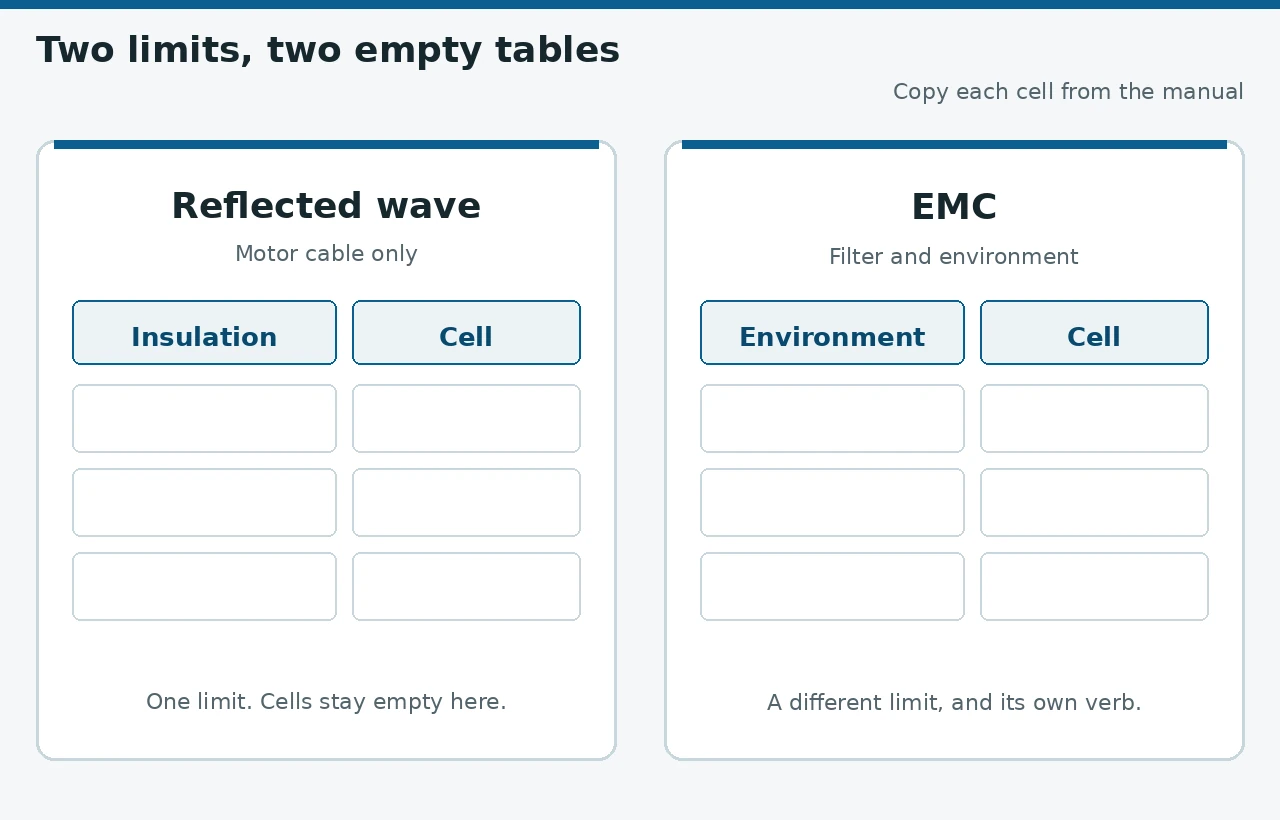
Takeaway: Record which table, which column and which verb. A single "maximum cable length" cell on your form is a sign that two limits have been merged.
What is the installed route, and what cable is it?
The length that goes into the register is the length of the cable as it is installed or planned, with its unit: the run through trays and conduit, the drops, any service loop at either end and every parallel conductor. Measure or estimate the route itself, not the distance between the drive cabinet and the motor on a floor plan. "Not measured" is an acceptable entry; it keeps the row open.
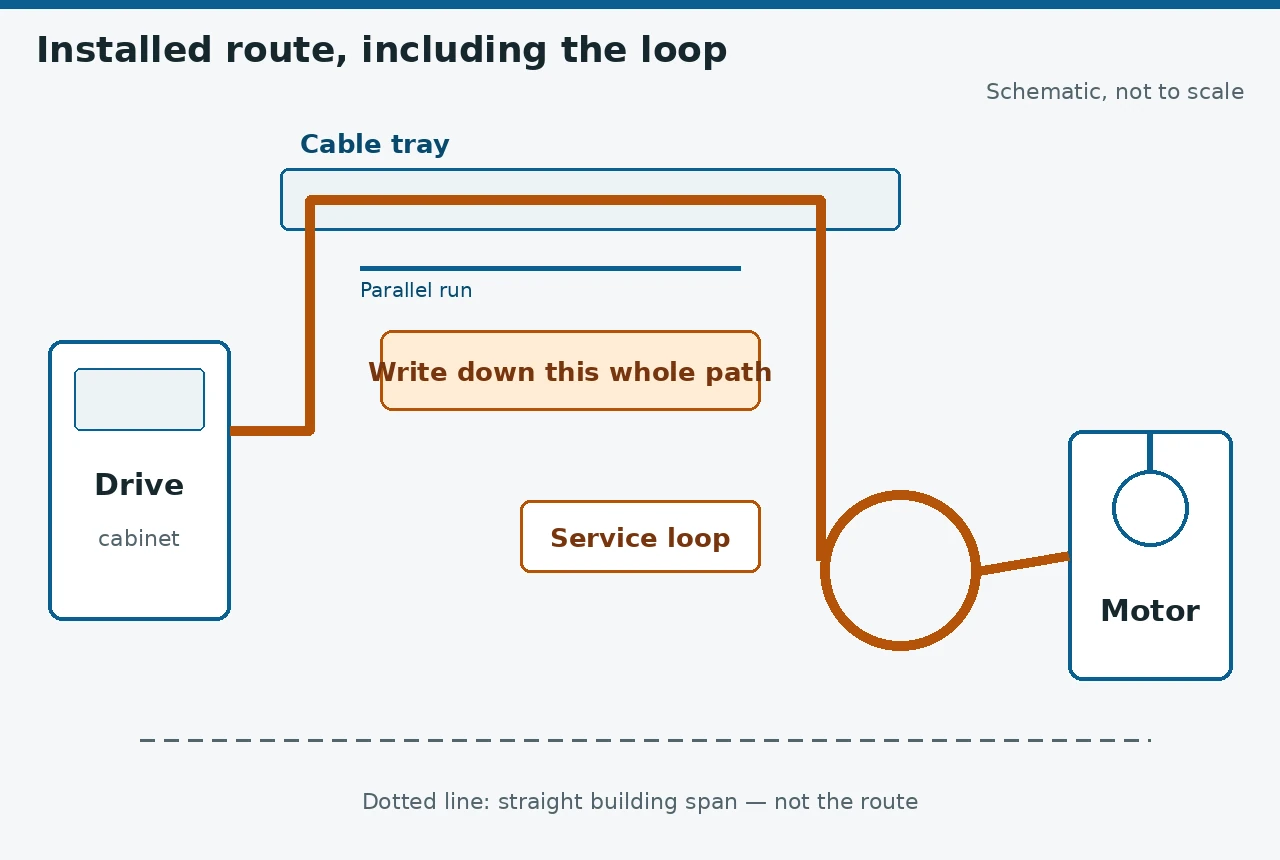
Construction. The route record also has to name the cable construction: conductor insulation, shield type and shield coverage. The manual we read recommends a braided-shield construction and gives a cable as an example, then warns that other shielded constructions may limit the allowable length and that cable not shown as tested in its distance tables is not recommended, with its performance against those limits unknown. A shielded cable that manual did not test is therefore not covered by its distance table. Write "unknown construction" until a datasheet says otherwise, and write "not covered by the table" when the datasheet describes a construction the manual's tables do not. The manual also refers one shielded-cable distance question to a separate publication; we did not read it, so that point stays "manual names another publication; not read."
Control wiring. The same manual has a separate limit for control wiring. That limit is for control and signal conductors, not for the motor power cable. Record it on its own row so it is never copied onto the motor cable, and keep general terminal, grounding and shield-termination layout to VFD wiring basics.
Takeaway: The route row is the installed path with loops and parallel conductors, and the construction row decides whether the manual's table covers that cable at all.
What output device, if any, is approved?
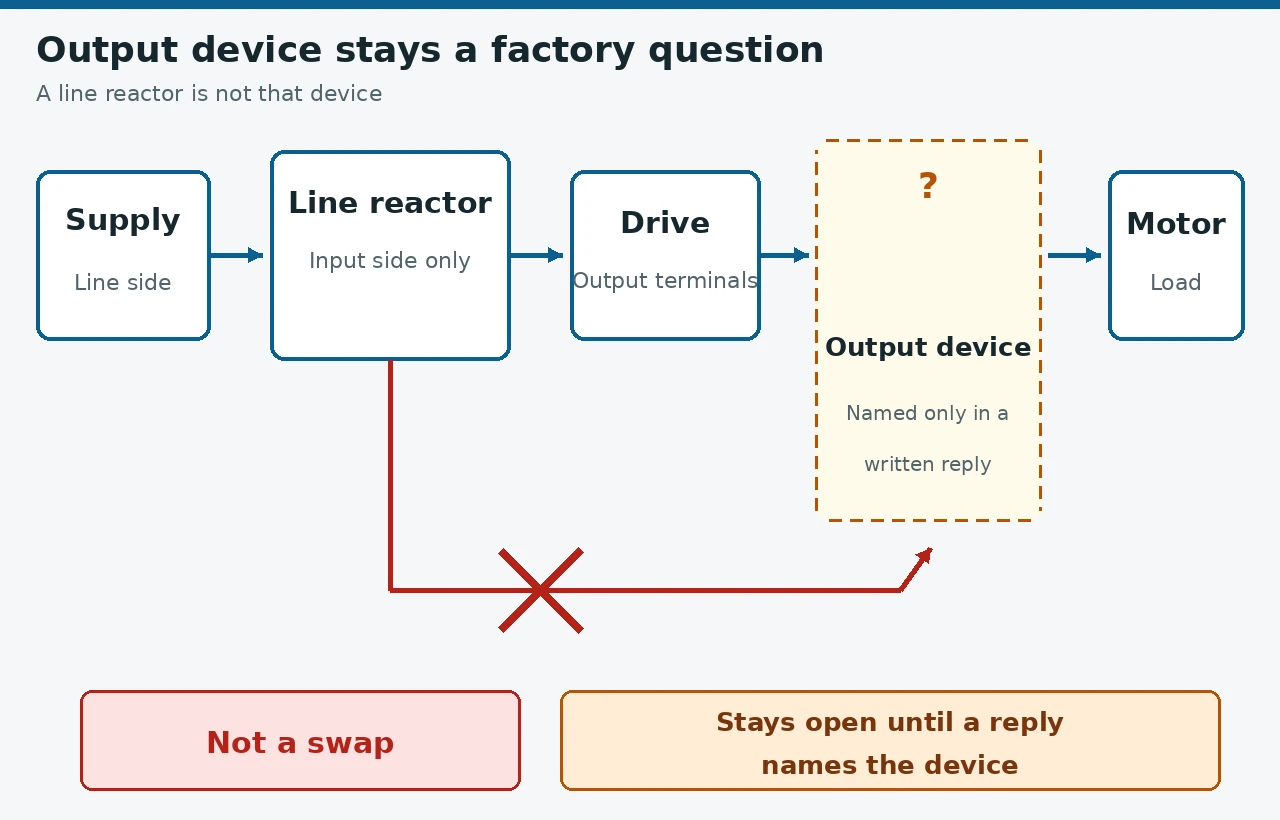
If the route is longer than the motor-cable-only cell in the manual, the register stays "manufacturer approval open" until a written reply names the output device for that catalog number. The manual we read says longer cable can be achieved with devices on the drive output and tells the reader to consult the factory. It does not name a reactor, a dV/dt filter or a sine-wave filter there, and it does not give a longer distance. "Consult factory / unresolved" is a complete answer for this row.
Output reactors, dV/dt filters and sine-wave filters are different products, and none of them is interchangeable with another just because each sits on the drive output. A line reactor is not one of them at all: in the manual we read, line reactors are input-side measures for supply conditions. Keep input reactors, DC chokes and input EMC filters off the motor-cable row; what they do on the line side is explained in VFD harmonics and line reactors.
Filter announcements. A drive maker's published filter announcement can state a long unscreened cable length for the drives it names, and that announcement is still not your manual. Record it in the register only when your drive nameplate and your filter match the drives and the filter the announcement names. Otherwise leave it out and keep the output-device row open.
Our power quality products page lists power-quality hardware categories. It is a catalog, not an approval of any filter for any cable length.
Takeaway: An output device belongs in the register only when a document for your catalog number names it. Until then, "approval open" is the correct entry.
The motor-cable limit register
Copy this register and fill it from the documents you have. Every blank cell is intentional. A blank cell is not a result, and an open row is a valid outcome. Write the source for each entry: publication number, revision and page, or the date and sender of a manufacturer reply.
| Row | What you write | Empty until | Your entry | Source (document, revision, page or reply) | Status (filled / open) |
|---|---|---|---|---|---|
| 1. Drive nameplate | Complete catalog number, voltage rating, manual publication and revision | A family name is not a row | |||
| 2. Motor nameplate and insulation | Voltage, current, any peak or inverter-duty insulation figure, and the document that states it | "Not measured" stays not measured | |||
| 3. Cable route | Length of the installed or planned path, including loops and parallel conductors, with unit | A straight-line building distance is not it | |||
| 4. Cable construction | Conductor insulation, shield type and shield coverage | "Unknown construction" | |||
| 5. Reflected-wave limit | The table cell and the motor-insulation column used, or "not in this manual" | One distance cannot fill rows 5 and 6 | |||
| 6. EMC limit | The table cell for the filter catalog number and the EMC environment column used | One distance cannot fill rows 5 and 6 | |||
| 7. Manual verb | The words printed on each page ("not exceeded," "at least," or what is actually there) | Do not correct the manual | |||
| 8. Output device | None, or the device the manual or a written manufacturer reply names for this catalog number | "Consult factory / unresolved" | |||
| 9. Filter announcement (if any) | Title and date, recorded only if it names your drive and your filter | Nameplates match the announcement | |||
| 10. Control wiring | The manual's control-wiring limit, kept for control and signal conductors only | Never copied onto rows 3, 5 or 6 | |||
| 11. Still open | The manufacturer approval that is not in hand | An open cell is a valid result |
横向滑动或滚动以查看所有列。
Read it simply. The route in row 3 is compared with rows 5 and 6 separately, using the verb in row 7. If either comparison is unresolved, or the route needs an output device that row 8 cannot name from a document, row 11 lists it and the length is not yet accepted. Neither this page nor a conversation with us replaces the manufacturer's written answer.
The how to choose a VFD guide asks for motor cable length when you describe an application; this register is how that length is documented. Once the register shows which catalog number the documents actually permit, you can look for it among our variable frequency drives. If the motor itself is still open, compare candidates on industrial motors with the insulation row in mind.
Takeaway: The register is finished when every row has a source or an honest "open." It is not finished when someone has typed a distance into an empty cell.
When this does not apply
- Input harmonics and line reactors. Line-side distortion and the devices that address it are a different subject, covered in the harmonics guide linked above.
- Terminal, grounding and shield-termination layout. General wiring practice belongs to the wiring guide linked above, and the exact drawing for your drive.
- Cable ampacity and conduit fill. Conductor sizing for current, installation method and local electrical code is outside this register.
- Single-phase input permission. Whether a drive may run from a single-phase supply is its own documented approval.
- Braking-resistor sizing. Resistor cable and duty follow the braking section of the drive manual.
Even inside those topics, a universal cutoff distance or an automatic swap of one filter for another is outside what this page supports.
Frequently asked questions
What is the recommended cable length between a VFD and a motor?
There is no general figure to copy. The permitted distance is the cell in the manual for your complete catalog number, your motor's insulation evidence and your EMC condition, and a manual can print a reflected-wave limit and an EMC limit separately. Fill rows 5 and 6 of the register from those pages.
Why does motor cable length matter for a VFD?
The drive's output pulses travel down the motor cable and can reflect at the motor terminals, raising the voltage peaks the insulation sees. Separately, cable length is one of the conditions in the drive's EMC table. A long route can affect either limit, or both.
If my run fits the reflected-wave table, is the EMC length settled too?
No. They are different limits in the same manual. Record each on its own row, with its own column and the verb printed on its page.
Can a line reactor let me run a longer motor cable?
Not as a substitute for an output device. In the manual we read, line reactors are input-side measures. A longer motor cable depends on an output device the manual or a written manufacturer reply names for your catalog number; until then the row stays "manufacturer approval open."
Does the control-wiring limit in the manual apply to the motor cable?
No. It covers control and signal conductors. Keep it on its own row so it is never copied onto the motor power cable.
What if I do not know the cable's shield construction?
Write "unknown construction" and leave the row open. A shielded construction the manual did not test is not covered by its distance table, so the construction has to be known before the reflected-wave row can be read.
What to send us
If you want a second look at the register, send the records you already have. Unknown or unresolved is fine; mark it that way.
| Item | Why we need it | Example format |
|---|---|---|
| Motor nameplate | Insulation and voltage have to match the manual column | Photo or typed voltage, current and any insulation marking |
| Drive nameplate | The table belongs to the complete catalog number | Photo or full catalog string; blank if there is no drive yet |
| Route and construction | Loops, parallel runs and shield coverage change which cell applies | Length with unit, or "not measured"; shield coverage, or "unknown" |
| Manual references already in hand | The reflected-wave page and the EMC page are different limits | Publication number, revision, page, or "not opened" |
| Output device, if any | Only a written match extends the motor-cable-only cell | Catalog number of the device, or "none / unresolved" |
| Partly filled register | Shows which rows are still open | Copy of the register above |
横向滑动或滚动以查看所有列。
Send these records through WhatsApp. We read them and tell you which register rows are still open, and whether a document you already hold is the manual for that nameplate. We do not approve a cable length, a filter substitution, a price or a ship date; the length approval stays with the drive manufacturer and the qualified person responsible for the installation.
Editorial basis
Reviewed 13 October 2026. This register is compiled from public manufacturer documents. It is not a test, a measurement, a certification or an approval of any drive, filter or cable, and the distance cells in these documents are manual-specific, so they are not reprinted here.
- Rockwell Automation PowerFlex 40P User Manual, publication 22D-UM001F-EN-E — September 2024; read for its reflected-wave, cable-construction, EMC-filter and control-wiring statements. Its distance cells apply to that bulletin only.
- Danfoss: Design more freely with extended unscreened motor cable length — news page dated 19 April 2021; cited only as an example of a filter announcement tied to the drives it names. Its statements remain the supplier's claims.
Cable-length limits, filter options and EMC conditions differ by exact catalog number, firmware, motor and installation. Confirm every row against the current manual for the drive on your nameplate.